The word “investing” can feel intimidating. It often conjures images of frantic traders on Wall Street, complex charts, and the fear of losing hard-earned money. But at its core, investing is simply the process of putting your money to work for you, with the goal of building wealth over time.
If you’re in the USA, you have access to one of the most dynamic and accessible financial markets in the world. The power of compounding—where your investment earnings themselves generate more earnings—can turn small, consistent contributions into significant sums over the years. Whether your goal is retirement, a down payment on a house, funding your child’s education, or simply achieving financial independence, investing is the most reliable vehicle to get you there.
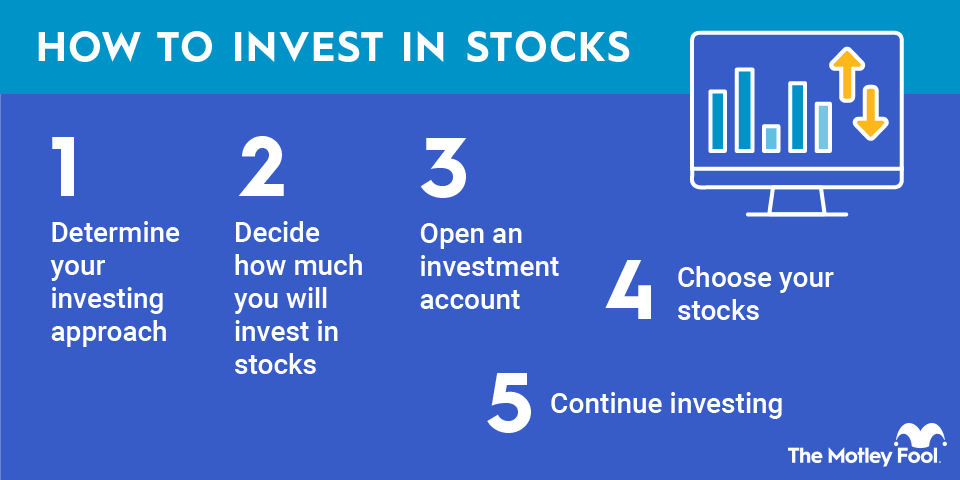
This guide is designed to demystify the entire process. We will walk through five clear, actionable steps that will take you from being a curious observer to a confident, proactive investor. We’ll prioritize foundational principles over get-rich-quick schemes, focusing on strategies that are endorsed by financial experts and have stood the test of time.
Step 1: Lay Your Foundation – Get Financially Grounded
Before you invest your first dollar, it’s crucial to ensure your personal finances are on solid ground. Investing is a marathon, not a sprint, and you need a strong base to run the race successfully.
A. Tame Your Debt
Not all debt is created equal. High-interest consumer debt, like credit card balances and payday loans, can have interest rates of 15%, 20%, or even higher. This debt actively works against your financial health.
- The Rule of Thumb: Prioritize paying off high-interest debt before you begin significant investing. The guaranteed “return” you get by eliminating a 20% interest charge is far higher and more certain than the average 7-10% annual return you might expect from the stock market over the long run.
- Manageable Debt: Lower-interest debt, such as a federal student loan (3-6%) or a mortgage (4-7%), is less of an emergency. You can typically manage these payments while also investing.
B. Build an Emergency Fund
An emergency fund is your financial safety net. It’s a stash of cash designed to cover unexpected expenses like car repairs, medical bills, or job loss. Without it, you might be forced to sell your investments at a loss to cover an emergency, derailing your long-term plan.
- How Much? Aim for 3 to 6 months’ worth of essential living expenses.
- Where to Keep It: This money should be liquid and safe—not in the stock market. A high-yield savings account (HYSA) is the perfect vehicle. HYSAs, offered by online banks, provide much higher interest rates than traditional brick-and-mortar savings accounts, allowing your cash to earn a modest return while remaining fully accessible.
C. Define Your Investment Goals and Timeline
Why are you investing? Your answer will shape every decision you make.
- Short-Term Goals (1-3 years): Saving for a car, a vacation, or a wedding. For these, the stock market is generally too risky. Capital preservation is key. Consider a high-yield savings account or short-term CDs.
- Medium-Term Goals (3-10 years): Saving for a down payment on a house. A mix of conservative investments might be appropriate, but with a 5+ year horizon, you can consider some stock market exposure.
- Long-Term Goals (10+ years): This is where investing truly shines. Retirement is the most common long-term goal. With decades ahead of you, you can afford to take on more risk (volatility) for the potential of higher returns, as you have time to recover from market downturns.
Step 2: Open Your Gateway – Choose an Investment Account
You can’t buy stocks or funds directly; you need a specialized financial account known as a brokerage account. Think of it as the shopping cart you use to hold your investments.
Types of Investment Accounts in the USA
- Taxable Brokerage Account: This is a standard, flexible account. You can put in after-tax money, and any growth (dividends, capital gains) is subject to taxes in the year it’s realized. There are no contribution limits or restrictions on when you can withdraw your money.
- Tax-Advantaged Retirement Accounts (The Powerhouses):
- 401(k) (or 403(b) for non-profits): Offered by employers. Contributions are often made pre-tax (lowering your taxable income now), and investments grow tax-deferred. You pay income tax when you withdraw in retirement. Many employers offer a “match”—free money you should never leave on the table.
- Individual Retirement Arrangement (IRA): An account you open yourself. You can choose a Traditional IRA (potential tax-deductible contributions, tax-deferred growth) or a Roth IRA (contributions are made with after-tax money, but withdrawals in retirement are completely tax-free). For 2024, the contribution limit for IRAs is $7,000 ($8,000 if you’re 50 or older).
How to Choose an Online Broker
For most beginners, an online broker is the best choice due to low costs and user-friendly platforms. Key factors to consider:
- Fees and Commissions: The best brokers today charge $0 commissions for trading stocks and ETFs. Ensure there are no account maintenance fees.
- Account Minimums: Many top brokers have $0 minimums to open an account.
- Ease of Use: The website and mobile app should be intuitive and easy to navigate.
- Educational Resources: Look for brokers that offer robust learning tools, articles, and webinars.
- Investment Selection: Ensure they offer a wide range of low-cost ETFs and mutual funds.
Top Brokerage Picks for Beginners (2024):
- Fidelity Investments: Excellent all-around choice with no fees, great research, and stellar customer service.
- Charles Schwab: Similar to Fidelity, with a strong platform and no fees. Owns TD Ameritrade.
- Vanguard: The pioneer of low-cost index investing, ideal for buy-and-hold investors. Known for its client-owned structure.
- E*TRADE / Morgan Stanley: A powerful platform now integrated with Morgan Stanley.
- M1 Finance: Unique for its “pie” system, great for automated, customizable portfolio building.
Step 3: Learn the Language – Understand Your Investment Choices
You have your account funded. Now, what do you actually buy? Let’s break down the most common asset classes and vehicles.
Core Asset Classes
- Stocks (Equities): When you buy a stock, you are buying a small piece of ownership, or a “share,” in a publicly traded company (e.g., Apple, Coca-Cola, Tesla). Stocks offer high growth potential but come with higher volatility (price swings).
- Bonds (Fixed Income): When you buy a bond, you are essentially loaning money to a government or corporation. In return, they promise to pay you a fixed interest rate and return your principal at a future date. Bonds are generally more stable than stocks but offer lower potential returns.
- Cash & Cash Equivalents: This includes your savings account, money market funds, and Certificates of Deposit (CDs). They offer the highest safety and liquidity but the lowest returns, often barely keeping pace with inflation.
The Best Investment Vehicles for Beginners
While you could buy individual stocks, it’s risky and requires significant research. For beginners, diversification—spreading your money across many investments—is the key to managing risk. The easiest way to achieve instant diversification is through funds.
- Exchange-Traded Funds (ETFs): These are baskets of securities (like stocks or bonds) that trade on an exchange, just like a stock. They are the modern investor’s best friend.
- Why they’re great for beginners:
- Diversification: A single S&P 500 ETF holds 500 different companies.
- Low Cost: They have low expense ratios (annual fees).
- Transparency: You always know what’s inside them.
- Liquidity: You can buy and sell them anytime the market is open.
- Why they’re great for beginners:
- Index Funds: A type of mutual fund or ETF that automatically tracks a specific market index, like the S&P 500. They are passive investments, meaning a manager isn’t actively picking stocks. This passivity is what keeps their fees so low. For all intents and purposes, an index fund ETF (like VOO, which tracks the S&P 500) is the gold standard for beginner investors.
- Mutual Funds: Similar to ETFs but priced once per day after the market closes. While many are excellent and low-cost (like Vanguard’s index mutual funds), they sometimes have higher minimum investments than ETFs.
Read more: Investing in Your Future: A Millennial & Gen Z Guide to the US Market
Step 4: Build Your Portfolio – Craft Your Investment Strategy
Now for the exciting part: putting it all together. Your strategy should be a reflection of the foundation you built in Step 1.
A. Determine Your Asset Allocation
This is the single most important decision you will make—how you divide your money between stocks, bonds, and other assets. Your allocation is your primary lever for controlling risk.
A common rule of thumb is the “100 minus age” rule:
- A 30-year-old might allocate
100 - 30 = 70%to stocks and 30% to bonds. - This is just a starting point. A more aggressive investor might use “110 minus age,” while a more conservative one might use “90 minus age.”
Sample Allocations Based on Timeline & Risk:
- Aggressive (Long-Term/High Risk Tolerance): 90% Stocks / 10% Bonds
- Moderate (Medium-Term/Moderate Risk Tolerance): 60% Stocks / 40% Bonds
- Conservative (Short-Term/Low Risk Tolerance): 30% Stocks / 70% Bonds
B. Implement with a Simple, Powerful Portfolio
You don’t need a complex portfolio to win. In fact, simplicity is a superpower. Here are two classic, diversified portfolio examples you can build entirely with low-cost ETFs:
1. The Three-Fund Portfolio (A Boglehead Favorite)
This portfolio is legendary for its simplicity and effectiveness. It provides global diversification across US stocks, international stocks, and US bonds.
- 50% – VTI (Vanguard Total Stock Market ETF): Holds every publicly traded US stock, from giants like Microsoft to the smallest companies.
- 30% – VXUS (Vanguard Total International Stock ETF): Provides exposure to stock markets outside the USA.
- 20% – BND (Vanguard Total Bond Market ETF): Holds a wide range of US government and high-quality corporate bonds.
2. The All-Equity (S&P 500) Portfolio for the Very Aggressive Young Investor
- 100% – VOO (Vanguard S&P 500 ETF) or IVV (iShares Core S&P 500 ETF): This invests solely in the 500 largest companies in the US. It’s pure stock market exposure. While riskier than a portfolio with bonds, it has strong historical returns and is incredibly simple.
C. Execute Your Plan: The Mechanics of Buying
- Log in to your brokerage account.
- Find the trade ticket. It’s usually labeled “Trade” or “Buy/Sell.”
- Enter the ticker symbol of the ETF you want (e.g., VTI).
- Select the order type. For beginners, a “Market Order” is fine—it means “buy this at the best available price right now.”
- Enter the number of shares or the dollar amount you wish to invest.
- Review and submit the order.
Step 5: Master the Mindset – Manage, Monitor, and Stay the Course
The hardest part of investing isn’t math; it’s psychology. Your behavior during market swings will determine your ultimate success more than any single stock pick.
A. Embrace Dollar-Cost Averaging (DCA)
Dollar-cost averaging is the practice of investing a fixed amount of money on a regular schedule (e.g., $500 every month), regardless of what the market is doing.
- Why it works: When prices are high, your $500 buys fewer shares. When prices are low, it buys more shares. This smoothes out your average purchase price over time and removes the emotion and pressure of trying to “time the market.” Setting up automatic investments is the ultimate form of DCA.
B. Stay Disciplined Through Market Volatility
The market will go down—sometimes dramatically. This is a feature, not a bug. Historically, every major downturn has been followed by a recovery to new highs.
- What to do in a crash: For a long-term investor, the best strategy is almost always to do nothing. Or, if you have cash, to continue investing as scheduled. Selling during a panic locks in losses. Remember: You only lose money if you sell.
C. Rebalance Your Portfolio Periodically
Over time, your asset allocation will drift. If stocks have a great year, your 70/30 portfolio might become an 80/20 portfolio, taking on more risk than you intended.
- Rebalancing is the process of selling some of the outperforming assets and buying more of the underperforming ones to return to your target allocation. Do this once a year or when your allocation drifts by more than 5%. This forces you to “buy low and sell high” systematically.
The Final Word: Start Now, Tune Out the Noise
The most powerful force in investing is time. The sooner you start, the more time compounding has to work its magic. Don’t get paralyzed by the quest for the perfect portfolio or the perfect moment. The best time to plant a tree was 20 years ago. The second-best time is now.
Open your account, choose a simple, diversified portfolio, set up automatic contributions, and focus on living your life. Avoid the hype of financial news and social media. Your consistent, disciplined approach will be the true driver of your financial success.
Read more: The Ultimate Guide to US Dividend Stocks: Building a Passive Income Stream
Frequently Asked Questions (FAQ)
Q1: How much money do I need to start investing?
A: You can start with virtually any amount. Many brokers have no minimums, and with fractional shares offered by platforms like Fidelity and Schwab, you can buy a piece of an ETF or stock with as little as $1. The important thing is to start the habit.
Q2: Is investing in the stock market like gambling?
A: No, when done correctly, it is not. Gambling is typically a short-term bet with odds stacked against you. Investing is a long-term commitment to owning pieces of profitable businesses that grow in value over time. While there is always risk, a diversified, long-term strategy is based on the historical upward trajectory of the global economy, not chance.
Q3: I’m scared of losing money. What should I do?
A: This is a normal feeling. The key is to reframe your perspective. See short-term market drops as “sales” where investments are available at a lower price. Focus on your long-term horizon (10+ years), where the risk of loss diminishes significantly. Starting with a more conservative asset allocation (more bonds) can also help you sleep at night while you get comfortable.
Q4: What’s the difference between a ETF and a mutual fund?
A: The main differences for a beginner are:
- Trading: ETFs trade like stocks throughout the day. Mutual funds are priced and traded once after the market closes.
- Minimums: ETFs have a share price as their minimum (which can be bypassed with fractional shares). Mutual funds sometimes have initial minimum investments ($1,000-$3,000).
For all practical purposes, a low-cost index ETF is an excellent choice for a new investor.
Q5: How do I know if I should use a Roth IRA or a Traditional IRA?
A: The core question is: do you expect to be in a higher or lower tax bracket in retirement?
- Choose a Roth IRA if you’re young, early in your career, and expect to be in a higher tax bracket when you retire. Paying taxes now at your current lower rate is a benefit.
- Choose a Traditional IRA if you are in your peak earning years (and within the income limits for deductibility) and expect to be in a lower tax bracket in retirement. The tax deduction today is more valuable.
Q6: Should I use a robo-advisor?
A: Robo-advisors (like Betterment or Wealthfront) are a great “set-it-and-forget-it” option. They automatically build and manage a diversified ETF portfolio for you for a small fee (around 0.25%). They are perfect for beginners who want a completely hands-off approach. Doing it yourself through a major broker is slightly cheaper and offers more control, but requires a bit more engagement.
Q7: How often should I check my portfolio?
A: Less is more. Constantly checking your portfolio can lead to emotional, reactive decisions. For a long-term investor, checking once a quarter or even once a year when you rebalance is perfectly sufficient. Your portfolio is like a bar of soap—the more you handle it, the smaller it gets.