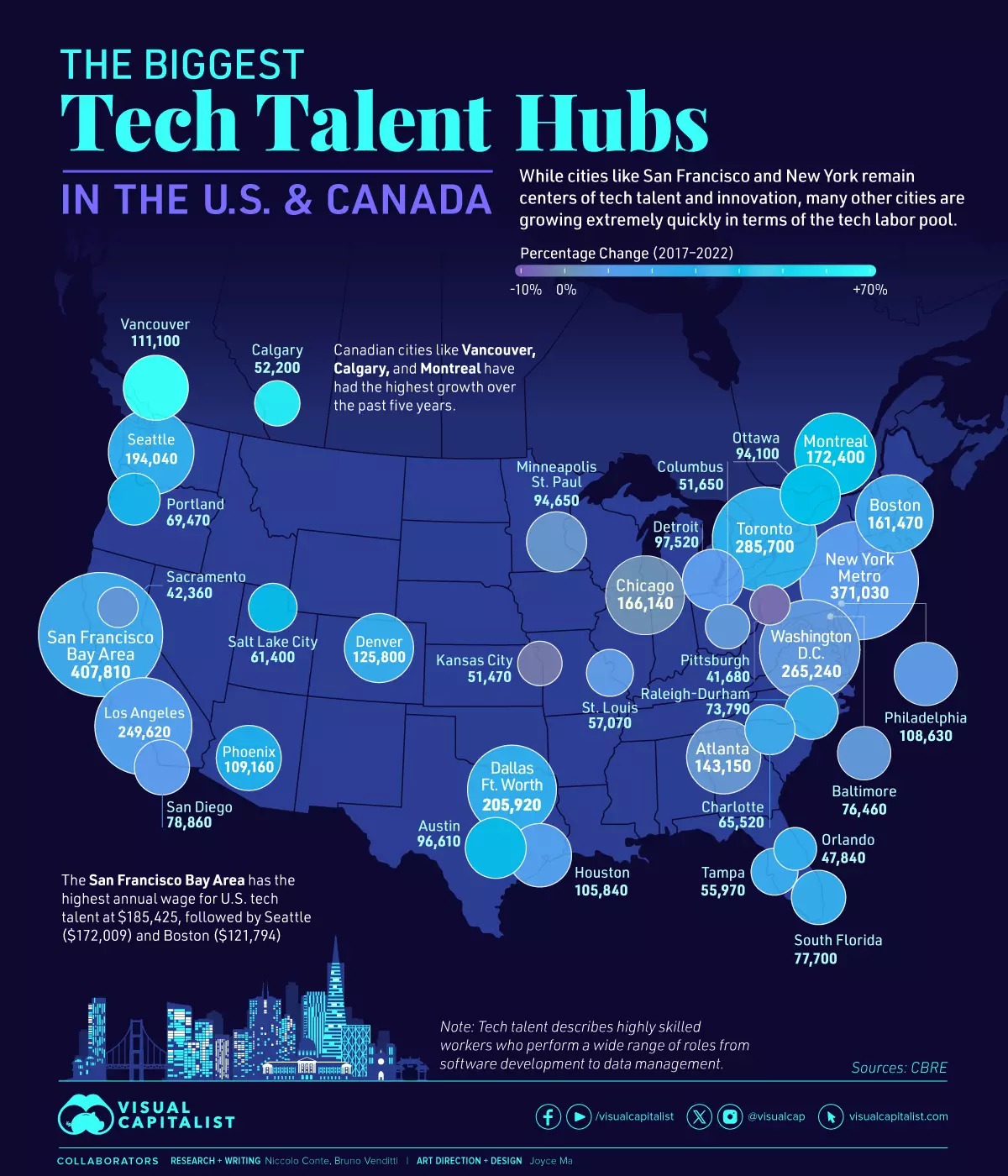
For decades, the global tech narrative was dominated by a single, powerful mantra: “Go West, young founder.” Silicon Valley, with its potent alchemy of venture capital, Stanford University, and a culture that celebrated both success and failure, was the undisputed epicenter of technological innovation. It was more than a location; it was a state of mind, a proving ground, and the ultimate destination for anyone with a disruptive idea and a dream of an IPO.
But a profound shift is underway. The map of American innovation is being redrawn, not by erasing Silicon Valley, but by illuminating a constellation of new stars across the country. A combination of soaring costs in the Bay Area, the normalization of remote work, a hunger for a better quality of life, and a strategic push from local governments and investors has catalyzed the rise of a new generation of tech hubs. These emerging ecosystems are not mere replicas of their Californian predecessor; they are forging their own identities, specializing in industries where they hold unique, home-field advantages, from aerospace in Los Angeles and life sciences in Boston to fintech in Miami and advanced manufacturing in the “Silicon Heartland.”
This article serves as your guide to this new geography of American innovation. We will move beyond the headlines to map these emerging tech hubs and investment hotspots, exploring the specific sectors they dominate, the unique factors fueling their growth, and the tangible opportunities they present for founders, investors, and talent seeking a new frontier.
The Great Dispersion: Why Now?
The exodus from Silicon Valley is not a sudden event but the acceleration of a long-brewing trend, supercharged by recent global shifts. Several key factors have converged to make this “Great Dispersion” not just possible, but inevitable.
- The Remote Work Revolution: The COVID-19 pandemic acted as a forced experiment, proving that large-scale, distributed work could be not only feasible but often more productive. This untethered tech talent from the need to live within a punishingly expensive commute of a Bay Area office. Suddenly, engineers, designers, and marketers could take their high salaries and work from cities where the cost of living allowed for a higher quality of life.
- The Cost Arbitrage Opportunity: The math is stark. The average home price in the San Francisco metro area is multiples higher than in cities like Austin, Atlanta, or Raleigh. For bootstrapped startups and venture funds mindful of burn rates, relocating or opening a secondary office in a more affordable city means capital stretches further, runway extends, and the path to profitability becomes clearer.
- Maturation of Local Ecosystems: A thriving tech hub requires more than just cheap office space. It needs capital, talent, and mentorship. Over the past decade, successful “exits” (IPOs and acquisitions) in cities like Seattle, Boulder, and Boston have created a new generation of angel investors and venture capitalists who are now reinvesting locally. Furthermore, top-tier research universities have become powerful engines of talent and R&D, spinning out startups and producing skilled graduates.
- Industry Specialization (The “Right to Win”): New hubs are succeeding not by trying to be everything to everyone, but by doubling down on their inherent strengths. They leverage their historical industries, local corporate anchors, and academic research to dominate specific verticals. This specialization creates powerful network effects, attracting talent, companies, and capital within a specific niche.
- Proactive Public and Private Partnerships: Many state and city governments are no longer waiting for innovation to happen; they are actively courting it. Through targeted tax incentives, investment in infrastructure (like broadband), and initiatives to support STEM education, they are creating fertile ground for tech companies to put down roots.
Mapping the New Frontier: A Regional Breakdown
To understand this new landscape, we can group the emerging hubs into distinct regional clusters, each with its own character and competitive advantages.
Tier 1: The Established Challengers
These ecosystems are well beyond “emerging.” They are mature, robust, and have already produced numerous world-class companies. They represent the most direct and credible alternatives to Silicon Valley.
1. Seattle & The Pacific Northwest
- Core Strengths: Cloud Computing, Enterprise Software, E-Commerce, Life Sciences, AI/ML.
- The Anchors: The presence of Amazon and Microsoft is the gravitational center of this ecosystem. These tech titans act as immense talent magnets and incubators, with countless alumni spinning out to found their own ventures.
- The Vibe: A potent blend of big-tech corporate power and a gritty, outdoorsy startup culture. The University of Washington is a top-tier research institution, particularly in computer science and medicine, feeding the talent pipeline.
- Investment Landscape: Robust, with a strong presence of venture firms like Madrona Venture Group (a local stalwart) and Ignition Partners, alongside significant satellite offices for all major Bay Area VCs.
- Key Companies: Amazon, Microsoft, Starbucks, Expedia, Zillow, Tableau (acquired by Salesforce), Snowflake (founded there), F5 Networks.
2. Boston & Cambridge
- Core Strengths: Biotech, Life Sciences, Pharmaceuticals, Robotics, AI, Fintech, Higher Ed Tech.
- The Anchors: The unparalleled concentration of world-class universities—Harvard, MIT, Tufts, Boston University—forms the bedrock of this ecosystem. MIT, in particular, is a relentless engine of deep-tech innovation and spinouts.
- The Vibe: Academic, research-driven, and intellectually rigorous. The Kendall Square area in Cambridge is often described as the most innovative square mile on the planet, densely packed with biotech firms, research labs, and venture capital.
- Investment Landscape: Deeply specialized, with firms like General Catalyst, Pillar VC, and Flagship Pioneering (which literally pioneers new life science companies) providing not just capital but deep scientific expertise.
- Key Companies: Moderna, Biogen, Boston Dynamics, Wayfair, DraftKings, HubSpot.
3. Austin, Texas
- Core Strengths: Semiconductors, Software, Gaming, Space Tech, “Silicon Hills.”
- The Anchors: A long-standing tech presence with Dell and IBM, now supercharged by massive corporate expansions from Tesla, Oracle, and Apple. The University of Texas at Austin provides a strong talent base, especially in engineering.
- The Vibe: A magnetic “keep Austin weird” culture that blends live music, great food, and a vibrant outdoor scene with a business-friendly, low-tax environment. It has become a top destination for California expats.
- Investment Landscape: Once reliant on outside capital, Austin now boasts a growing local VC scene with firms like S3 Ventures and Capital Factory, though it still attracts massive interest from coastal investors.
- Key Companies: Dell, Tesla (Gigafactory), Oracle (HQ), Apple (Campus), Samsung (massive chip plant being built), Indeed, SpaceX (expanding presence).
Tier 2: The Rapidly Ascending Hubs
These cities have moved from promising upstarts to legitimate, high-growth tech centers with vibrant communities and accelerating investment.
4. Miami & South Florida
- Core Strengths: Fintech, Crypto/Web3, Venture Capital, Real Estate Tech, Climate Tech.
- The Catalyst: While Miami has had a growing tech scene for years, the “Miami Movement” was ignited in late 2020 by Mayor Francis Suarez’s viral tweet, “How can I help?” This open invitation, combined with a focus on becoming the capital of the digital asset world, created unprecedented momentum.
- The Vibe: International, glamorous, and transactional. It leverages its position as a gateway to Latin America, its favorable tax climate, and a 24/7 lifestyle that appeals to a new generation of founders and investors.
- Investment Landscape: Explosive. Led by homegrown firms like eMerge Americas and Founders Fund, it has also seen an influx of VCs and angel investors relocating from the Northeast and California.
- Key Companies: OpenSea (HQ move), Blockchain.com, eMerge Americas, Magic Leap, a plethora of fast-growing fintech startups.
5. Denver & Boulder, Colorado
- Core Strengths: Aerospace, SaaS, DevOps, Outdoor/Tourism Tech, Cleantech.
- The Anchors: A powerful combination of a major aerospace presence (Lockheed Martin, Ball Aerospace, United Launch Alliance) and a highly educated, outdoors-oriented workforce that values work-life balance.
- The Vibe: Active, collaborative, and less cut-throat than coastal hubs. The “Boulder Bubble” is famous for its dense, walkable startup community and a culture that prioritizes lifestyle alongside ambition.
- Investment Landscape: Strong and growing, with local firms like Foundry Group and Access Venture Partners, and a very active angel investor network.
- Key Companies: Google (Boulder campus), Palantir (relocated from Palo Alto), Gusto, SendGrid (acquired by Twilio), Zoom Video (major Denver office).
6. Research Triangle Park (Raleigh-Durham-Chapel Hill), North Carolina
- Core Strengths: Life Sciences, Biotech, Health IT, Enterprise Software, Cleantech.
- The Anchors: The triumvirate of Duke University, UNC Chapel Hill, and North Carolina State University creates a world-class talent and research pipeline. The long-standing Research Triangle Park is a model for public-private partnership.
- The Vibe: Academic, collaborative, and family-friendly. It offers a high quality of life at a relatively low cost, attracting scientists, researchers, and engineers.
- Investment Landscape: Specialized in life sciences and tech, with firms like Hatteras Venture Partners and Pappas Capital playing key roles.
- Key Companies: IBM, Cisco, Red Hat (acquired by IBM), Epic Games, Biogen, a massive number of clinical-stage biotech firms.
Tier 3: The Next Wave & Specialized Ecosystems
These cities are building impressive momentum and are poised for significant growth, often around a few key specializations.
7. Atlanta, Georgia
- Core Strengths: Fintech, Logistics & Supply Chain, SaaS, Media Tech.
- The Anchors: Home to the world’s busiest airport and a massive logistics network, Atlanta is a natural hub for supply chain innovation. It’s also the headquarters of titans like The Home Depot and Coca-Cola, which spawns enterprise software needs and B2B opportunities. The Atlanta University Center is a leading consortium of Historically Black Colleges and Universities (HBCUs), contributing to a diverse and robust talent pool.
- Key Companies: Mailchimp (acquired by Intuit), NCR, Global Payments, Honeywell, and a thriving scene of fintech startups like Greenlight and Kabbage.
8. Nashville, Tennessee
- Core Strengths: HealthTech, Digital Health, Corporate Headquarters.
- The Anchors: Nashville is the nation’s healthcare industry capital, home to Hospital Corporation of America (HCA) and over 500 other healthcare companies. This density of industry expertise creates an unparalleled environment for health-tech innovation.
- Key Companies: HCA, Change Healthcare, numerous startups focused on everything from electronic health records to patient engagement platforms.
9. The “Silicon Heartland” (Columbus, Ohio & Pittsburgh, Pennsylvania)
- Core Strengths: Advanced Manufacturing, Robotics, Autonomous Vehicles, Logistics, AgTech.
- The Anchors: This region is at the heart of the U.S. industrial and manufacturing base. Columbus is a logistics powerhouse and a testing ground for smart city tech. Pittsburgh has successfully transformed its economy through Carnegie Mellon University’s world-leading robotics and AI programs.
- Key Companies: Columbus: Root Insurance, Olive AI, Intel (building two massive new chip factories). Pittsburgh: Aurora Innovation, Duolingo, Argo AI.
10. Salt Lake City & The “Silicon Slopes,” Utah
- Core Strengths: SaaS, DevOps, AdTech, Family-Oriented Tech.
- The Anchors: A highly educated, hard-working talent pool, often with multilingual skills from Mormon missions. A culture of entrepreneurship and a stunning natural environment make it highly attractive. The state government is famously business-friendly.
- Key Companies: Qualtrics, Domo, Pluralsight, Ancestry.
Read more: Decoding the American Consumer 2025: A Market Analysis of Post-Inflation Spending Habits
The Investment Thesis: Where is the Smart Money Flowing?
For venture capitalists and angel investors, this geographic shift is more than a trend; it’s a fundamental re-evaluation of where to find the best risk-adjusted returns.
- Sector-Specific Bets: Investors are following the specialization. Biotech VCs are in Boston and Raleigh. Fintech funds are piling into Miami and Atlanta. Those focused on enterprise SaaS have a presence in Denver and Salt Lake City. This allows for deeper domain expertise and better due diligence.
- The Talent Arbitrage: Investing in companies outside major hubs can mean getting access to top-tier talent at a lower burn rate. A Series A round in Kansas City goes much further than the same round in San Francisco, reducing dilution for founders and investors and extending the company’s runway to find product-market fit.
- The Rise of Local “Super Angel” and Micro-VCs: The creation of wealth in these hubs has led to the rise of local investors who have “been there, done that.” These individuals and small funds provide crucial seed capital and hands-on mentorship that is contextually relevant to the local market.
- Corporate Venture Capital (CVC): Major corporations with headquarters or large presences in these hubs are becoming active investors through their CVC arms. This provides startups not just with capital, but with potential pilot customers, distribution channels, and industry credibility.
Navigating the Challenges
This golden age of distributed innovation is not without its headwinds. The very factors that fueled the rise of these new hubs are now creating their own challenges.
- Growing Pains: As Austin, Miami, and Denver boom, they face skyrocketing housing costs, traffic congestion, and infrastructure strain—echoing the very problems that drove people away from Silicon Valley.
- The “Series B Crunch”: Many of these ecosystems have become excellent at seeding startups. However, a gap can sometimes exist in the later-stage funding rounds (Series B and beyond), which historically required a flight to coastal VCs. While this is changing rapidly, it remains a consideration for founders planning their long-term capital strategy.
- Talent Competition: The war for talent is no longer a Bay Area phenomenon. Startups in Nashville now compete with each other and with giant healthcare corporations for the same specialized engineers and product managers, driving up local salaries.
Conclusion: A More Resilient and Diverse American Innovation Ecosystem
The rise of tech hubs beyond Silicon Valley is not a zero-sum game. It is a sign of a maturing, diversifying, and ultimately more resilient national innovation ecosystem. A country that centralizes its most promising technologies and brightest minds in one geographically vulnerable, astronomically expensive region is taking an enormous risk.
The new map of American tech is a tapestry woven with different threads: the deep-tech rigor of Boston, the cloud infrastructure of Seattle, the life-saving science of Research Triangle, the financial daring of Miami, and the industrial transformation of the Heartland. This decentralization fosters a healthier competition of ideas, provides more on-ramps to the innovation economy for a diverse range of people, and ensures that the future of American technology is built on a broader, more stable foundation.
For founders, the message is one of empowerment: you can now build a world-class company from a much wider array of locations, tailoring your company’s HQ to your industry, your culture, and your personal life. For investors, it’s a call to look beyond the 280 and 101 freeways for the next generation of outsized returns. And for talent, it’s an invitation to build a career in tech without sacrificing the quality of life you desire.
The American tech story is no longer a monologue from the West Coast. It is a vibrant, national conversation. And it’s just getting started.
Read more: Small-Cap vs. Large-Cap Stocks: Which Segment Looks Stronger?
Frequently Asked Questions (FAQ)
Q1: Is Silicon Valley still relevant, or is it dying?
Silicon Valley is absolutely not dying. It remains the global leader in venture capital concentration and is still home to an unparalleled density of tech giants, top talent, and venture firms. However, its relative share of U.S. tech activity is decreasing. It is evolving, not disappearing, and will likely remain the center for certain deep-tech and late-stage funding activities while ceding ground in other areas.
Q2: As a software engineer, which of these hubs offers the best balance of opportunity and cost of living?
This is subjective, but cities like Austin, Denver, Atlanta, and Raleigh consistently rank highly. They offer robust job markets with competitive tech salaries, while the cost of housing (though rising) is significantly more manageable than in San Francisco, New York, or Boston. They also provide a high quality of life with access to culture, nature, and amenities.
Q3: What is the biggest risk for a startup choosing to base itself in an emerging hub?
The primary risk has historically been access to sufficient capital at all stages. While seed funding is now widely available, there can still be a gap in later-stage (Series B/C+) funding, potentially forcing a company to seek investors from the coasts or relocate. However, this gap is closing rapidly as more VC firms open offices in these hubs and local funds grow larger.
Q4: How are these hubs addressing the issue of diversity and inclusion in tech?
This varies by city, but many emerging hubs have a unique opportunity to build inclusive cultures from the ground up, unlike older ecosystems that are trying to retrofit D&I initiatives. Cities like Atlanta, with its strong HBCU presence, have a natural advantage in cultivating a diverse talent pipeline. Most hubs now have active organizations and community groups dedicated to supporting underrepresented founders and technologists.
Q5: For a non-U.S. founder looking to expand to the United States, which hub would you recommend?
The best choice depends entirely on your industry.
- Fintech/Crypto: Miami is the undeniable hotspot, with a strong international and Latin American focus.
- Life Sciences/Biotech: Boston or Research Triangle Park are the epicenters.
- Enterprise SaaS/AI: Seattle, Denver, or Salt Lake City offer deep talent pools.
- Gaming/Media Tech: Los Angeles or Austin are major centers.
It’s crucial to align your company’s needs with the specific strengths and network of a hub.
Q6: Are these trends reversible if remote work becomes less popular?
While a full-scale return-to-office mandate from major companies could slow the dispersion, it is unlikely to reverse it. The genie is out of the bottle. The infrastructure of these new hubs—the VC firms, the incubators, the successful exits, the community networks—is now firmly established. These ecosystems have achieved a level of self-sustaining critical mass that will endure regardless of the exact future of remote work policies. The shift is structural, not cyclical.