For millions of Americans, the word “retirement” is synonymous with the “401(k).” It’s the default option, the box checked on the first day of a new job, the subject of watercooler conversations about company matches. And for good reason: the 401(k) and its cousin, the 403(b) for non-profit employees, are powerful, accessible, and often subsidized by an employer.
But here is the fundamental truth that every future retiree must understand: Your 401(k) is not your retirement plan. It is merely one component—a single pillar—in a much larger, more robust structure you must build to achieve a secure and fulfilling retirement.
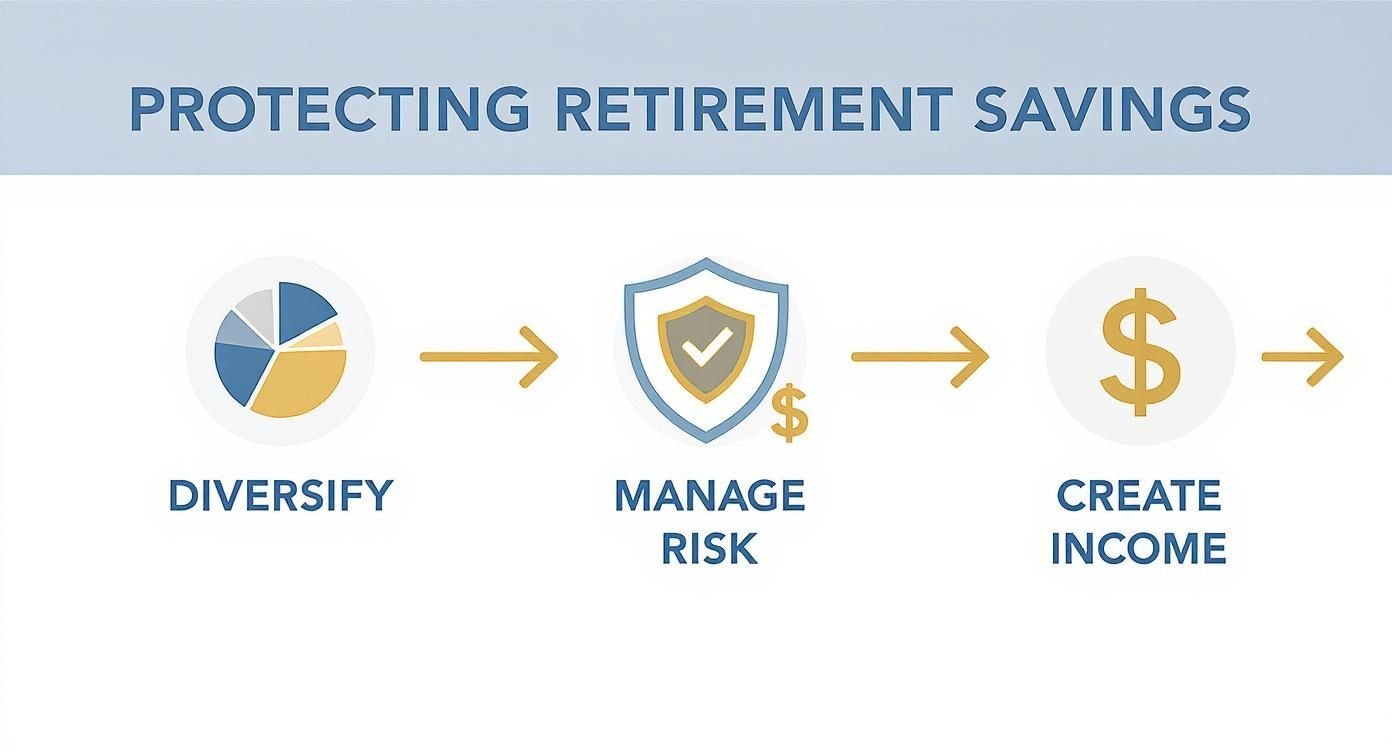
Relying solely on a 401(k) is like building a house with only a foundation. It’s a necessary start, but it provides no shelter from the storms of market volatility, inflation, and unforeseen life events. A truly resilient retirement plan is built upon three distinct, yet interconnected, pillars. Mastering these pillars—understanding their unique roles, strengths, and limitations—is the key to transitioning from simply saving for retirement to strategically building lasting wealth and security.
This article will serve as your master guide. We will move beyond the myopic focus on the 401(k) and delve into the comprehensive framework that constitutes a modern, intelligent retirement strategy.
The Limitation of a One-Pillar Plan
Before we build the three-pillar structure, it’s crucial to understand why the 401(k)-only approach is fraught with risk.
- Contribution Limits: For 2024, the 401(k) contribution limit is $23,000 ($30,500 for those 50+). While this is substantial, for high-earners or those who got a late start, it may be insufficient to accumulate the necessary nest egg.
- Limited Investment Choices: Your 401(k) plan is a curated menu by your employer and the plan administrator. You cannot pick individual stocks or just any ETF. You are confined to the two dozen or so funds offered, which may have higher fees (expense ratios) than comparable investments available in an IRA.
- Lack of Liquidity and Access Penalties: The money in your 401(k) is purpose-built for retirement. Withdrawals before age 59 ½ typically incur a 10% early withdrawal penalty on top of ordinary income taxes, making it a poor source for emergency funds or mid-life opportunities.
- Concentration Risk: Having the vast majority of your retirement assets in a single, tax-deferred account type creates a “tax-time bomb.” In retirement, every dollar you withdraw will be taxed as ordinary income, which could push you into a higher tax bracket and impact the taxation of your Social Security benefits.
A resilient strategy diversifies not just across stocks and bonds, but across account types and tax treatments. This is the core philosophy behind the three-pillar approach.
Pillar 1: The Employer-Sponsored Plan (The Automated Foundation)
This is the pillar most people know, but few truly master. It includes the 401(k), 403(b), 457(b), and the Thrift Savings Plan (TSP) for federal employees.
The Primary Advantage: The Employer Match
This is the closest thing to free money you will ever get. If your employer offers a 5% match, and you contribute 5% of your salary, you are instantly earning a 100% return on that portion of your investment before it even has a chance to grow. Failing to contribute at least enough to get the full company match is leaving compensation on the table.
Mastering Your 401(k): A Strategic Guide
- Contribution Hierarchy: Your first goal is to contribute enough to get the full match. Your next goal, after mastering Pillar 2, might be to max out the annual contribution limit.
- Fund Selection – Looking Beyond the Name: Don’t just pick a “2060 Target-Date Fund” and forget it. Understand the underlying funds.
- Expense Ratios: This is the single most important predictor of net returns. In a 401(k), you are stuck with the offered funds, but you can always choose the ones with the lowest fees. A difference of 0.5% in fees can cost you hundreds of thousands of dollars over a career.
- Asset Allocation: Ensure your chosen funds provide diversification across US stocks, international stocks, and bonds. A simple, effective three-fund portfolio within your 401(k) is often achievable.
- The Roth 401(k) Option: Many plans now offer a Roth option. Here, you contribute post-tax dollars, but all qualified withdrawals in retirement are 100% tax-free. This is a powerful tool, especially if you believe you are in a lower tax bracket now than you will be in retirement.
- The Mega Backdoor Roth (Advanced Strategy): Some 401(k) plans allow for “after-tax” contributions (distinct from Roth) beyond the standard $23,000 limit, up to a total of $69,000 for 2024. If your plan permits, you can immediately convert these after-tax contributions to a Roth 401(k) or Roth IRA. This is a complex but incredibly powerful way to supercharge your tax-free retirement savings.
When to Prioritize This Pillar:
- When your employer offers a matching contribution.
- When you are a disciplined saver who benefits from “set-it-and-forget-it” automated contributions.
- When you have high-income and need the high contribution limits to save effectively.
Pillar 2: The Individual Retirement Arrangement (IRA) & Health Savings Account (HSA) (The Strategic Engine)
If Pillar 1 is your automated foundation, Pillar 2 is your strategic command center. This is where you gain control, flexibility, and powerful tax advantages that you direct yourself.
Part A: The IRA Landscape
There are two main types of IRAs, and choosing the right one is a critical annual decision.
1. The Traditional IRA:
- Tax Treatment: Contributions are often tax-deductible in the year you make them, reducing your taxable income. Investments grow tax-deferred. Withdrawals in retirement are taxed as ordinary income.
- Income Limits: The deductibility of Traditional IRA contributions phases out if you (or your spouse) are covered by a retirement plan at work and your income exceeds certain levels (e.g., for 2024, phase-out begins at $77,000 for single filers).
- Best For: Individuals who do not have a workplace plan, or those who have a workplace plan but their income is below the phase-out range and they want a current-year tax deduction.
2. The Roth IRA: The Crown Jewel of Retirement Accounts
- Tax Treatment: Contributions are made with post-tax dollars (no current-year deduction). The monumental benefit is that all growth and qualified withdrawals in retirement are completely tax-free.
- Income Limits: The ability to contribute to a Roth IRA phases out at higher income levels (e.g., for 2024, phase-out begins at $146,000 for single filers). However, there is a well-known loophole called the “Backdoor Roth IRA,” which allows high-income earners to contribute to a Traditional IRA and then immediately convert it to a Roth IRA, bypassing the income limits entirely.
- Why the Roth IRA is So Powerful:
- Tax Diversification: It provides tax-free income in retirement, balancing the taxable income you’ll take from your 401(k) and Traditional IRA. This allows you to manage your tax bracket strategically in retirement.
- Flexibility: You can withdraw your contributions (but not earnings) at any time, for any reason, without taxes or penalties. This makes it a semi-emergency fund of last resort.
- Hedge Against Future Tax Hikes: With national debt at record levels, many experts believe tax rates will be higher in the future. Paying taxes now at a known rate can be a brilliant bet.
Mastering Your IRA:
- Contribution Priority: After securing your 401(k) match, the next dollar should often go to maxing out your IRA (2024 limit: $7,000, or $8,000 if 50+), due to its superior investment flexibility and the power of the Roth.
- Investment Universe: Unlike your 401(k), an IRA at a brokerage like Vanguard, Fidelity, or Charles Schwab gives you access to the entire market—every stock, ETF, mutual fund, and bond. You can build a perfectly optimized, low-cost portfolio.
Part B: The Health Savings Account (HSA) – The Stealth Retirement Super-Saver
If the Roth IRA is the crown jewel, the HSA is the secret treasure chest. To use an HSA, you must be enrolled in a High-Deductible Health Plan (HDHP).
The Triple Tax Advantage:
- Tax-Deductible Contributions: Contributions are made with pre-tax dollars, reducing your taxable income.
- Tax-Free Growth: Investments within the HSA grow tax-free.
- Tax-Free Withdrawals: Withdrawals for qualified medical expenses are completely tax-free.
The Retirement Strategy:
While HSAs are designed for medical costs, their tax advantages make them the most tax-efficient account in the US tax code. The optimal long-term strategy is to:
- Contribute the maximum annual amount (2024: $4,150 for self-only, $8,300 for family).
- Pay for current medical expenses out-of-pocket if you can afford to.
- Invest the HSA funds in a prudent portfolio, just like an IRA.
- Let the account grow, untouched, for decades.
In retirement, you can withdraw funds tax-free for any qualified medical expense (including Medicare premiums, long-term care insurance, and out-of-pocket costs). After age 65, you can make withdrawals for any reason without penalty; they are simply taxed as ordinary income (like a Traditional IRA), making it a powerful supplemental retirement account even for non-medical costs.
Pillar 2 Integration: The flow is key. Fund your 401(k) to the match, then max out your HSA (if eligible), then max out your IRA (prioritizing Roth via Backdoor if needed). This sequence captures the most powerful tax benefits available.
Read more: State of the Union: A Sector-by-Sector Snapshot of the U.S. Economy
Pillar 3: The Taxable Brokerage Account & Other Assets (The Freedom Pillar)
Pillars 1 and 2 are tax-advantaged, meaning the government gives you a break in exchange for rules about access. Pillar 3 has no such tax advantages, but it also has no such rules. This is your platform for ultimate flexibility.
The Taxable Brokerage Account
This is a standard investment account with a brokerage firm. You contribute post-tax money, and you pay taxes on the dividends and capital gains as they occur.
Why This Pillar is Essential:
- Unlimited Contributions and Liquidity: There are no contribution limits and no penalties for withdrawing at any time, for any reason. This is your fund for pre-retirement goals—a down payment on a rental property, starting a business, a sabbatical, or a large purchase.
- Tax-Efficient Investing (Tax-Loss Harvesting): In a taxable account, you can use investment losses to your advantage. By selling a security at a loss, you can use that loss to offset capital gains or even up to $3,000 of ordinary income, reducing your tax bill. This is a sophisticated strategy that is impossible in tax-advantaged accounts.
- Favorable Tax Rates: Long-term capital gains (on assets held for more than one year) and qualified dividends are taxed at preferential rates (0%, 15%, or 20%), which are typically lower than ordinary income tax rates.
- Estate Planning Benefits: Assets in a taxable account receive a “step-up in basis” upon your death. This means your heirs inherit the asset at its current market value, and the capital gains that accrued during your lifetime are erased for tax purposes.
Beyond the Brokerage: Real Assets
Pillar 3 also encompasses tangible assets that form part of your net worth and can generate income or appreciate in value.
- Real Estate: This can be your primary residence, a rental property, or a Real Estate Investment Trust (REIT). Real estate provides diversification, potential for appreciation, and a hedge against inflation.
- Other Investments: This could include owning a business, peer-to-peer lending, or other alternative assets.
The Role of Pillar 3: It provides the freedom to retire before age 59 ½ without penalty, to handle life’s large and unexpected expenses, and to build generational wealth outside the confines of retirement-specific accounts.
Building Your Personal Three-Pillar Fortress: An Action Plan
Understanding the pillars is one thing; assembling them into a cohesive plan is another. Here is a step-by-step action plan, visualized in the flowchart below.
Now, let’s break down the steps in the flowchart.
Step 1: The Non-Negotiable Foundation
Your first move, before anything else, is to contribute enough to your employer’s 401(k) to get the full matching contribution. This is a 100% guaranteed return. If you do nothing else, do this.
Step 2: The Health and Wealth Assessment
Next, determine if you are eligible for and should enroll in a High-Deductible Health Plan (HDHP) with an HSA. If you are young, healthy, and have the cash flow to cover the higher deductible, the HSA’s triple tax advantage makes it a top-tier priority.
Step 3: Seize Control with an IRA
Whether or not you pursue an HSA, your next priority is to max out an IRA. For most people, especially younger earners or those who believe their income (and taxes) will be higher in the future, the Roth IRA is the default choice. If you exceed the income limits, execute the Backdoor Roth IRA strategy. The flexibility and tax-free growth are simply too valuable to ignore.
Step 4: Returning to the Employer Plan
Once your IRA is maxed out, circle back to your 401(k) and increase your contributions with the goal of hitting the annual maximum ($23,000 in 2024). At this stage, you are fully utilizing your primary tax-advantaged spaces.
Step 5: Achieving Total Financial Fluidity
If you have reached the contribution limits on your 401(k), IRA, and HSA, and you still have capital to invest, you graduate to the Taxable Brokerage Account. This is the mark of a sophisticated saver. Here, you focus on tax-efficient investments like broad-market index ETFs that generate minimal taxable dividends.
This systematic approach ensures you are not just saving, but saving optimally, capturing every available tax advantage while building a flexible, resilient financial fortress.
The Glue That Holds It All Together: Social Security
While not a “pillar” you directly control, Social Security is a critical component of the retirement income picture. It acts as a foundational, inflation-adjusted income stream. Your decision on when to claim benefits—early at 62, at Full Retirement Age (FRA 67 for most), or delayed until 70—has a profound impact on your overall plan.
- Claiming Early: Permanently reduces your monthly benefit.
- Delaying Until 70: Results in a significantly higher, guaranteed monthly benefit for life.
The optimal strategy often involves using withdrawals from your three pillars to bridge the gap between your retirement date and when you decide to claim Social Security, allowing you to delay and maximize that lifelong annuity.
Conclusion: From Saver to Master Builder
The journey to a secure retirement requires moving beyond the simplistic notion that a 401(k) alone is sufficient. It is a vital component, but only one part of a grander design.
- Pillar 1 (Employer Plans) provides an automated, high-capacity foundation, often with a company match.
- Pillar 2 (IRAs & HSAs) offers strategic control, superior tax advantages, and crucial flexibility.
- Pillar 3 (Taxable Accounts) delivers ultimate freedom and liquidity, unconstrained by government rules.
By understanding and diligently building each of these three pillars throughout your working life, you do more than just save. You architect a resilient, tax-efficient, and flexible financial future. You become the master of your retirement, capable of weathering market downturns, adapting to life’s changes, and stepping into your post-career life not with anxiety, but with confidence and control. The time to start building is now.
Read more: The Green Revolution: Market Opportunities in the U.S. Sustainable Economy
Frequently Asked Questions (FAQ)
Q1: I’m already 50 years old and haven’t saved much. Is it too late for this three-pillar approach?
A: It is absolutely not too late. While time is limited, the principles are more important than ever. You have access to “catch-up” contributions in your 401(k) and IRA, allowing you to save thousands more per year. Your focus should be aggressive savings: maximize every pillar, starting with the 401(k) match, then fully funding an IRA (with catch-up), and then returning to max out the 401(k) (with catch-up). Your asset allocation may be more conservative, but the structure of the three pillars remains the key to organizing your accelerated savings plan.
Q2: I have a high income and am phased out of direct Roth IRA contributions. Is the Backdoor Roth IRA really legal?
A: Yes, the Backdoor Roth IRA is a legal strategy that leverages the fact that the IRS allows anyone, regardless of income, to make non-deductible contributions to a Traditional IRA and then to convert those contributions to a Roth IRA. It has been used by millions of investors for years and has been explicitly acknowledged in Congressional legislation and by the IRS. It is a standard part of financial planning for high-income households.
Q3: How should my asset allocation differ across these three pillars?
A: This is an advanced but crucial question. The general rule is to view all your accounts as one unified portfolio.
- Taxable Accounts: Hold tax-efficient investments like broad-market stock index ETFs (e.g., VTI, ITOT) that generate low dividends. Avoid bonds and REITs here, as they generate highly taxable income.
- Tax-Deferred Accounts (401(k)/Traditional IRA): Ideal for placing less tax-efficient assets like bonds, REITs, and high-dividend stocks. The growth here is taxed as ordinary income anyway, so you shelter the high-tax investments.
- Tax-Free Accounts (Roth IRA/HSA): These are your “power plants” for growth. Because all withdrawals are tax-free, you should prioritize placing your highest-growth potential assets here, such as aggressive stock funds. You want this account to grow as large as possible, completely free of future taxes.
Q4: Should I ever prioritize a Taxable Brokerage Account over maxing out my 401(k)?
A: Rarely. The tax advantages of the 401(k) are almost always superior. The primary exception would be if you have a specific, short-to-medium-term financial goal (e.g., buying a house in 5 years) for which you need complete liquidity without the hassle of 401(k) loans or early withdrawal penalties. For pure retirement savings, the 401(k)’s tax deferral wins.
Q5: I’m self-employed. What are my options for Pillar 1?
A: As a self-employed individual, you have excellent options that often have higher contribution limits than a standard 401(k). These include:
- Solo 401(k): Allows for employee contributions up to $23,000 (2024) plus employer profit-sharing contributions up to 25% of compensation, for a total of up to $69,000.
- SEP IRA: Easier to set up but only allows for employer contributions up to 25% of net earnings, max $69,000.
- SIMPLE IRA: Allows for employee contributions up to $16,000 (2024) with a required employer match.
You can combine one of these with a personal IRA (Pillar 2) and a taxable account (Pillar 3) to create a robust three-pillar plan tailored to your business.