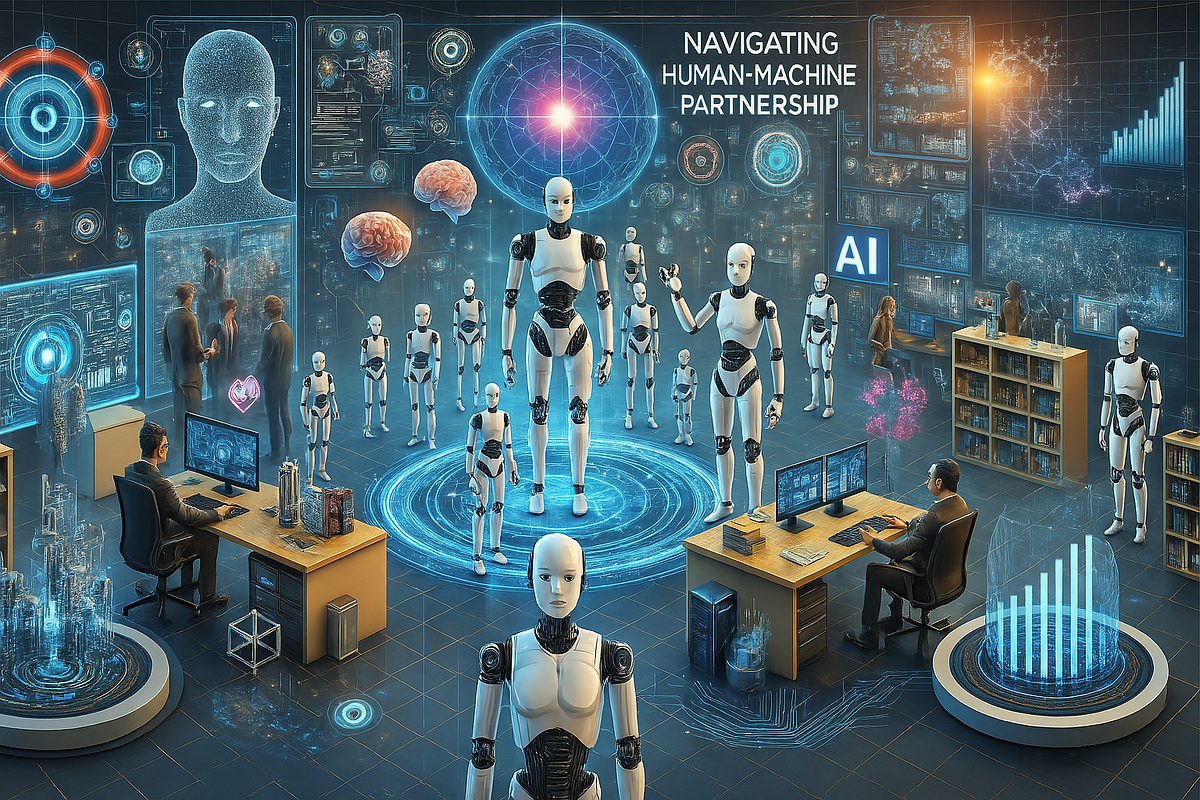
For decades, the image of the Wall Street fund manager has been etched into our collective consciousness: a sharp-suited, hyper-competitive individual, surrounded by Bloomberg terminals, making billion-dollar decisions based on experience, intuition, and a deep, hard-won understanding of the markets. This human-centric view of high finance is now facing its most formidable challenger: the autonomous, self-learning, and infinitely scalable Artificial Intelligence trading system.
The question is no longer if AI will change finance, but to what extent. Will AI systems become sophisticated tools in the human fund manager’s arsenal, or will they ultimately render the human portfolio manager obsolete? The answer is complex, nuanced, and critical for anyone with a stake in the financial markets. This article delves deep into the capabilities of modern AI, the enduring strengths of human intuition, and the most likely future—a symbiotic partnership that is already beginning to redefine the art and science of investing.
Part 1: The Rise of the Machines – Understanding AI in Trading
Before we can debate replacement, we must understand what we’re dealing with. AI trading is not a monolithic entity. It encompasses a spectrum of technologies, each with unique capabilities.
1. Machine Learning (ML) and Pattern Recognition:
At its core, ML involves algorithms that parse vast datasets, learn from the patterns they find, and make decisions or predictions without being explicitly programmed for every scenario. In trading, ML models can analyze decades of price data, fundamental indicators (P/E ratios, earnings reports), and macroeconomic data to identify subtle, non-linear patterns that are invisible to the human eye.
- Example: An ML model might learn that a specific combination of a weakening US dollar, rising oil inventories, and a slight flattening of the Treasury yield curve has, historically, led to a 70% probability of a rally in aerospace and defense stocks within 15 trading days.
2. Deep Learning and Neural Networks:
A more advanced subset of ML, deep learning uses artificial neural networks loosely modeled on the human brain. These multi-layered algorithms excel at processing unstructured data—the kind that constitutes about 80% of all available information.
- Example: A deep learning system can be trained to:
- Analyze Satellite Imagery: Count cars in retail parking lots to predict quarterly earnings for companies like Walmart or Home Depot.
- Process Natural Language (NLP): Scrape thousands of news articles, SEC filings, earnings call transcripts, and even social media posts to gauge market sentiment in real-time. It can detect subtle shifts in tone from “cautiously optimistic” to “concerned” in a CEO’s speech.
- Interpret Alternative Data: Analyze maritime shipping traffic, energy consumption data from IoT sensors, or credit card transaction aggregates to get a real-time pulse on global economic activity.
3. Reinforcement Learning:
This is where AI truly becomes “autonomous.” In reinforcement learning, an AI agent learns to make decisions by interacting with its environment (the market). It is rewarded for profitable trades and penalized for losses. Through millions of iterations of simulated trading, it develops a sophisticated, and often inscrutable, trading strategy on its own.
- Example: DeepMind’s AlphaZero, which famously mastered chess, Go, and Shogi in hours by playing against itself, demonstrates the potential of this approach. A reinforcement learning trading agent could develop a novel strategy that defies conventional human finance theory.
Part 2: The Unmatched Strengths of AI Trading Systems
The advantages of AI in the trading domain are not merely incremental; they are foundational and, in many areas, superhuman.
1. Speed and Scale:
An AI system can analyze millions of data points across global markets in milliseconds. It can execute thousands of trades simultaneously, capitalizing on micro-opportunities that exist for less than a second—a domain known as high-frequency trading (HFT) that is almost exclusively the realm of machines.
2. Emotionless Discipline:
Human traders are plagued by behavioral biases: fear of missing out (FOMO), loss aversion, anchoring, and overconfidence. An AI has no ego and no emotion. It executes its strategy with robotic discipline, sticking to pre-defined risk parameters regardless of whether the market is in a euphoric bubble or a panicked crash. This removes the single greatest source of human error in trading.
3. Unparalleled Data Processing Capacity:
No human team can read 10,000 news articles per minute, analyze satellite images of every major port in China, and process real-time consumer spending data while simultaneously monitoring currency fluctuations and bond yields. AI can. This ability to synthesize disparate, unstructured data streams into a coherent trading signal is arguably its most powerful advantage.
4. Continuous Learning and Adaptation:
The market is a dynamic, evolving system. A human’s strategy, based on their experience from the 2008 crisis, might not be relevant in a zero-interest-rate, meme-stock environment. AI models, especially those using reinforcement learning, can continuously adapt and retrain on new data, evolving their strategies to remain effective in new market regimes.
Read more: The American Retirement Blueprint: A Step-by-Step Guide for Getting Started
Part 3: The Irreplaceable Human Element?
Despite these formidable strengths, the notion of a completely human-free investment world is premature. Human fund managers possess several qualities that remain exceptionally difficult, if not impossible, to codify.
1. Qualitative and Contextual Understanding:
AI is brilliant at analyzing “what” is happening, but struggles with the “why.” It can detect that a pharmaceutical company’s stock is falling after a drug trial result, but can it understand the nuanced, long-term political, regulatory, and ethical landscape that will determine that company’s ultimate fate?
- The “Why” Matters: A human manager can grasp the significance of a change in Fed leadership, the geopolitical implications of a new trade deal, or the cultural shift that might make a new technology viable. This contextual, narrative understanding is crucial for long-term, strategic asset allocation.
2. Creative and Contrarian Thinking:
The most legendary trades in history were often deeply contrarian—betting against the dot-com bubble or buying during the depths of the 2008 financial crisis. This requires a form of creative conviction that goes against the data trend. An AI trained on historical data may be predisposed to follow the herd, as the herd is what creates the dominant pattern in the data. Human intuition, flawed as it can be, is also the source of groundbreaking, non-consensus insights.
3. Ethical and Macro-Social Judgment:
An AI’s sole purpose is to maximize its reward function (e.g., risk-adjusted returns). It has no inherent moral compass. A human manager can make decisions based on ESG (Environmental, Social, and Governance) criteria, avoiding industries like tobacco or firearms, even if they are profitable. They can also consider the macroeconomic stability and social impact of their strategies, something regulators are increasingly concerned about.
4. The “Black Swan” Problem:
Nassim Taleb’s concept of “Black Swan” events—highly improbable, high-impact occurrences—highlights a key AI weakness. AI models are trained on historical data. By definition, Black Swans are events with no historical precedent (e.g., the COVID-19 pandemic). In such scenarios, AI can fail catastrophically as its learned patterns become useless, while a human’s general reasoning and survival instincts might kick in.
Part 4: The Most Likely Future: A Symbiotic Partnership
The binary question of “replacement” is the wrong framework. The evidence points towards a powerful and enduring symbiosis—a partnership where human and machine strengths are combined to create a whole that is greater than the sum of its parts.
This model is often called “Augmented Intelligence.”
In this future, the role of the human fund manager will not disappear, but it will transform dramatically.
The New Role of the Human Fund Manager:
- The “AI Whisperer” and Strategist: The human’s primary role shifts from day-to-day stock picking to designing the overarching investment thesis and framework. They will be responsible for defining the objectives, constraints, and ethical boundaries for the AI systems to operate within. They ask the “big questions” that the AI then sets out to answer with data.
- The Interpreter of Anomalies: When the AI flags an anomaly or makes a trade that seems counter-intuitive, the human manager will step in. Their role will be to investigate the “why,” using their contextual understanding to determine if the AI has discovered a genuine new pattern or is reacting to spurious, flawed data.
- The Guardian of Risk and Ethics: Humans will provide the crucial oversight needed to prevent AI-driven catastrophes. This includes monitoring for “model drift” (when the AI’s strategy becomes less effective over time), ensuring compliance with evolving regulations, and intervening to override AI decisions that are profitable but ethically questionable or systemically risky.
- The Source of Creative Insight: Humans will focus on generating novel investment hypotheses. For example, a manager might identify a nascent technological trend like quantum computing or synthetic biology. They can then task the AI with scouring the globe for the most promising, under-the-radar companies in that space, effectively using the AI as a super-powered research assistant.
Real-World Example: Bridgewater Associates
The world’s largest hedge fund, founded by Ray Dalio, has been developing an ambitious system called “The Book of the Machine.” The goal is not to replace its human portfolio managers but to codify Bridgewater’s fundamental investment principles into a system that can advise managers in real-time, providing data-driven insights to inform their final decisions. This is augmentation in its purest form.
Conclusion: Evolution, Not Extinction
The autonomous AI trading system is not the end of the human fund manager. Rather, it is the catalyst for their evolution. The era of the fund manager who relies solely on gut instinct and traditional financial analysis is indeed waning.
The future belongs to a new breed of financial professional: one who is technologically literate, strategically minded, and possesses the humility to leverage AI’s immense power while providing the wisdom, context, and ethical oversight that only a human can. The most successful investment firms of the next decade will not be those with the smartest humans or the most powerful AI, but those that have most effectively engineered a collaborative and synergistic partnership between the two.
In the end, the question is not whether AI will replace human fund managers, but how humans who use AI will replace those who don’t.
Read more: Beyond the 401(k): Mastering the Three Pillars of US Retirement Savings
FAQ Section
Q1: Are AI trading systems already widely used in the US markets?
A: Absolutely. AI and algorithmic trading are already dominant in certain segments of the market, particularly in high-frequency trading (HFT), quantitative hedge funds (like Renaissance Technologies’ Medallion Fund), and for systematic strategies at large asset managers. Their use is rapidly expanding into traditional asset management as the technology proves its value.
Q2: Can a retail investor in the USA use AI for trading?
A: Yes, but with important caveats. There are numerous AI-powered trading platforms and “bots” marketed to retail investors. However, individuals must exercise extreme caution. Many of these systems are unproven, can be overly simplistic, and may not perform as advertised, especially during volatile market conditions. It is crucial to thoroughly research any platform, understand its strategy and fee structure, and never invest more than you are willing to lose.
Q3: What are the biggest risks of AI-driven trading?
A: The primary risks include:
- Model Risk: The AI’s strategy may be based on flawed assumptions or historical correlations that break down in the future.
- “Flash Crashes”: The hyper-speed interaction of AI systems can lead to cascading, rapid market declines, as seen in the 2010 “Flash Crash.”
- Over-Optimization: An AI can be so finely tuned to past data that it fails in live market conditions.
- Lack of Transparency (“Black Box”): Many complex AI models are inscrutable, making it difficult to understand why a trade was made, which poses challenges for risk management and regulatory compliance.
Q4: How are US regulators like the SEC dealing with AI in trading?
A: The SEC is actively scrutinizing the use of AI. Key areas of focus include:
- Algorithmic Bias: Ensuring that AI models do not create or exacerbate unfair market disparities.
- Transparency and Explainability: Pushing for greater clarity on how AI-driven decisions are made.
- Systemic Risk: Monitoring how widespread AI use could amplify risks to the entire financial system.
- Conflict of Interest: Investigating how platforms using AI to advise clients might prioritize their own profits (e.g., through payment for order flow).
We can expect more comprehensive regulations from the SEC and FINRA in the coming years to govern this rapidly evolving space.
Q5: If I’m an aspiring fund manager, should I learn to code?
A: While you may not need to become a senior software engineer, a strong functional understanding of data science, statistics, and the principles of AI and machine learning is becoming increasingly vital. Skills in Python, R, and SQL, along with the ability to work collaboratively with quantitative analysts and data scientists, will be a significant career advantage. The future fund manager is a bilingual professional, fluent in both finance and technology.