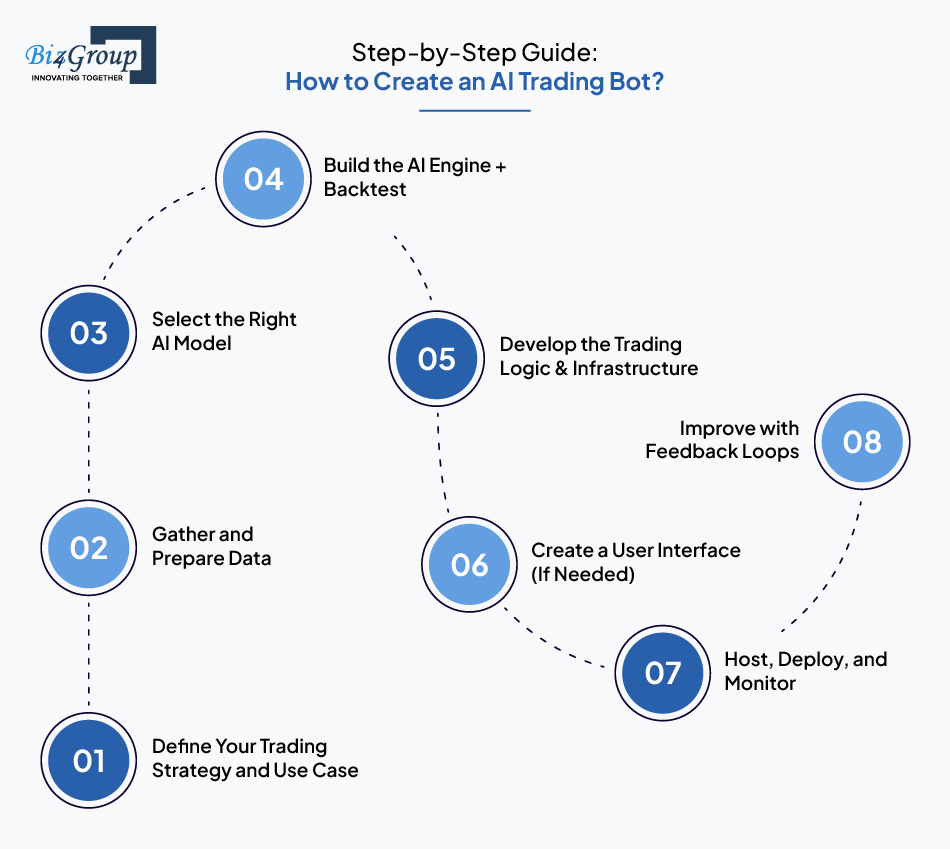
The term “Artificial Intelligence” in trading often conjures images of supercomputers in skyscrapers, executing millions of trades per second, far beyond the reach of the average person. This perception is both intimidating and misleading. The reality is that the core techniques of AI—machine learning (ML), statistical modeling, and data analysis—have become democratized. With a structured approach, disciplined risk management, and the right tools, a dedicated individual can build and test their own AI-driven trading strategy.
This guide is not a promise of effortless riches. Quite the opposite. It is a rigorous, step-by-step framework designed for those with a foundational understanding of markets and a willingness to learn some code. We will demystify the process, moving from conceptualization to a fully backtested prototype, all while emphasizing the critical pillars of risk management, validation, and continuous improvement. Our focus will be on the US equities markets (e.g., NYSE, NASDAQ) due to their high liquidity and data availability.
As an experienced quantitative analyst, I’ve built and overseen the development of numerous systematic strategies. The goal here is to distill that professional process into an accessible, ethical, and trustworthy roadmap for your first foray into AI trading.
Part 1: The Foundation – Philosophy, Prerequisites, and Tools
Before writing a single line of code, a successful strategy is born from a solid philosophical and practical foundation.
1.1 Defining Your Edge and Philosophical Approach
Why do you believe your strategy will work? “To make money” is not an edge. An edge is a repeatable, statistical advantage derived from a market inefficiency.
- Mean Reversion: The belief that prices and indicators tend to revert to their historical mean over time. (e.g., buying an oversold stock in an uptrend).
- Momentum/Trend Following: The belief that assets that have performed well in the recent past will continue to perform well in the near future. (e.g., “the trend is your friend”).
- Value-Based: Using fundamental data (P/E ratios, book value, etc.) to identify undervalued assets.
- Carry/Trend: Earning a small, consistent return from a structural feature of the market.
For your first strategy, we will focus on a simple Momentum-based approach. It’s intuitive, has a strong academic background, and is relatively straightforward to implement with AI.
1.2 Essential Prerequisites: Knowledge and Mindset
- Programming (Python): Python is the lingua franca of AI and data science. You don’t need to be an expert, but you must be comfortable with:
- Variables, data types, and loops.
- Using libraries (Pandas, NumPy).
- Basic data manipulation (filtering, grouping).
- Financial Knowledge: Understanding of basic market mechanics, what a candlestick chart is, and concepts like volatility, volume, and the bid-ask spread.
- Statistical Literacy: Familiarity with concepts like mean, standard deviation, correlation, and normal distribution is crucial.
- The Right Mindset: This is a marathon, not a sprint. Embrace a scientific, hypothesis-driven approach. You will have more failed ideas than successful ones—this is normal and part of the process.
1.3 Your Toolbox: Software and Data
Programming Environment:
- Jupyter Notebook: An interactive environment perfect for prototyping and exploratory data analysis.
- IDE (Integrated Development Environment): PyCharm or VS Code for larger, more structured projects.
Essential Python Libraries:
- Pandas & NumPy: For data manipulation and numerical operations.
- Scikit-Learn: The workhorse library for traditional machine learning algorithms (e.g., Linear Regression, Random Forests).
- XGBoost/LightGBM: Powerful libraries for gradient boosting, often very effective for financial data.
- Matplotlib/Seaborn: For data visualization and plotting.
- Backtrader/Zipline: Open-source backtesting frameworks.
Data Sources (A Critical Component):
The quality of your data dictates the quality of your model.
- Free/Cheap Tier:
- Yahoo Finance (via
yfinancelibrary): Excellent for end-of-day data. Good for starting. - Alpha Vantage/IEX Cloud: Offer free tiers with API access for both real-time and historical data.
- Yahoo Finance (via
- Professional Tier (Paid):
- Quandl: Now part of Nasdaq Data Link, offers high-quality fundamental and alternative data.
- Polygon.io: Robust API for real-time and historical US market data.
- Interactive Brokers: Their API provides access to real-time data if you have a funded account.
For this guide, we will use the yfinance library for its simplicity and zero cost.
Part 2: The Step-by-Step Framework in Action
We will now build a prototype strategy from the ground up. Our hypothesis is: “We can use a machine learning model trained on historical price and volume data to predict the short-term (5-day) future return of the SPY (SPDR S&P 500 ETF Trust) and generate profitable trading signals.”
Step 1: Problem Framing and Labeling
First, we must define what we are trying to predict. This is our “target variable” or “label.”
We are not predicting direction (“up” or “down”) as a simple classification. Instead, we will predict a continuous value: the 5-day forward return. This is a regression problem.
In Code:
We will load historical data for SPY and create our target variable.
python
import pandas as pd
import numpy as np
import yfinance as yf
import matplotlib.pyplot as plt

# 1. Download historical data
ticker = 'SPY'
data = yf.download(ticker, start='2010-01-01', end='2023-12-31')
data = data[['Open', 'High', 'Low', 'Close', 'Volume']] # Keep essential columns

# 2. Calculate the target variable: 5-day forward return
data['Future_Close'] = data['Close'].shift(-5)
data['Target'] = (data['Future_Close'] - data['Close']) / data['Close']
data = data.dropna() # Remove rows with NaN values

print(data[['Close', 'Future_Close', 'Target']].head(10))
Step 2: Feature Engineering – Creating the Model’s Inputs
Features are the input variables we provide to the model to help it learn the relationship with our target. Raw prices are often not useful; we need to create indicators.
We will create a set of common technical indicators:
- Moving Averages (Momentum):
SMA_5,SMA_20,SMA_50 - Moving Average Convergence Divergence (Momentum):
MACD,MACD_Signal - Relative Strength Index (Momentum/Mean Reversion):
RSI_14 - Bollinger Bands (Volatility/Mean Reversion):
BB_Upper,BB_Lower,BB_Width - Average True Range (Volatility):
ATR_14 - Price Rate-of-Change (Momentum):
ROC_10
In Code:
python
# 3. Feature Engineering
# Moving Averages
data['SMA_5'] = data['Close'].rolling(5).mean()
data['SMA_20'] = data['Close'].rolling(20).mean()
data['SMA_50'] = data['Close'].rolling(50).mean()

# RSI
def calculate_rsi(data, window=14):
    delta = data['Close'].diff()
    gain = (delta.where(delta > 0, 0)).rolling(window=window).mean()
    loss = (-delta.where(delta < 0, 0)).rolling(window=window).mean()
    rs = gain / loss
    rsi = 100 - (100 / (1 + rs))
    return rsi

data['RSI_14'] = calculate_rsi(data)

# MACD
exp1 = data['Close'].ewm(span=12).mean()
exp2 = data['Close'].ewm(span=26).mean()
data['MACD'] = exp1 - exp2
data['MACD_Signal'] = data['MACD'].ewm(span=9).mean()

# Bollinger Bands
data['BB_Middle'] = data['Close'].rolling(20).mean()
bb_std = data['Close'].rolling(20).std()
data['BB_Upper'] = data['BB_Middle'] + (bb_std * 2)
data['BB_Lower'] = data['BB_Middle'] - (bb_std * 2)
data['BB_Width'] = (data['BB_Upper'] - data['BB_Lower']) / data['BB_Middle']

# ATR
def calculate_atr(data, window=14):
    high_low = data['High'] - data['Low']
    high_close = np.abs(data['High'] - data['Close'].shift())
    low_close = np.abs(data['Low'] - data['Close'].shift())
    true_range = np.maximum(high_low, np.maximum(high_close, low_close))
    atr = true_range.rolling(window).mean()
    return atr

data['ATR_14'] = calculate_atr(data)

# Rate of Change
data['ROC_10'] = data['Close'].pct_change(periods=10)

# Drop rows with NaN values created by indicators
data = data.dropna()

print(data.columns)
Step 3: Data Preprocessing and Splitting
Before training, we must prepare our data.
- Handling Missing Values: We already used
dropna(). - Feature Selection: Create a list of the features we just engineered.
- Train/Validation/Test Split: This is critical to avoid overfitting. We split our data chronologically.
- Training Set (2010-2018): Used to train the model.
- Validation Set (2019-2021): Used to tune hyperparameters and validate performance.
- Test Set (2022-2023): A completely unseen dataset used for the final, unbiased evaluation of the strategy. Do not peek at this data during development!
In Code:
python
from sklearn.model_selection import train_test_split
from sklearn.preprocessing import StandardScaler

# 4. Define Features and Target
feature_list = ['SMA_5', 'SMA_20', 'SMA_50', 'RSI_14', 'MACD', 'MACD_Signal',
                'BB_Upper', 'BB_Lower', 'BB_Width', 'ATR_14', 'ROC_10']
features = data[feature_list]
target = data['Target']

# 5. Create a time-based split
split_date_1 = '2019-01-01'
split_date_2 = '2022-01-01'

train = data.loc[data.index < split_date_1]
val = data.loc[(data.index >= split_date_1) & (data.index < split_date_2)]
test = data.loc[data.index >= split_date_2]

X_train = train[feature_list]
y_train = train['Target']
X_val = val[feature_list]
y_val = val['Target']
X_test = test[feature_list]
y_test = test['Target']

# 6. Scale the features (very important for many ML models)
scaler = StandardScaler()
X_train_scaled = scaler.fit_transform(X_train)
X_val_scaled = scaler.transform(X_val)
X_test_scaled = scaler.transform(X_test)
Step 4: Model Selection and Training
We will start with a Random Forest Regressor. It’s robust, handles non-linear relationships well, and is less prone to overfitting than more complex models like deep neural networks for a first attempt.
In Code:
python
from sklearn.ensemble import RandomForestRegressor
from sklearn.metrics import mean_absolute_error, r2_score

# 7. Initialize and train the model
model = RandomForestRegressor(n_estimators=100, random_state=42, max_depth=10)
model.fit(X_train_scaled, y_train)

# 8. Make predictions on the validation set
train_pred = model.predict(X_train_scaled)
val_pred = model.predict(X_val_scaled)

# 9. Evaluate initial performance
print("Training MAE:", mean_absolute_error(y_train, train_pred))
print("Validation MAE:", mean_absolute_error(y_val, val_pred))
print("Training R2:", r2_score(y_train, train_pred))
print("Validation R2:", r2_score(y_val, val_pred))
If the validation performance is significantly worse than the training performance, it’s a sign of overfitting. We would then need to tune hyperparameters (like max_depth or n_estimators) to simplify the model.
Read more: Will Your Savings Last? Understanding Social Security, Medicare, and Long-Term Care Costs in the USA
Step 5: Generating Trading Signals and Building a Rule-Based Strategy
The model’s prediction is a number (the expected 5-day return). We need to translate this into an actionable trade signal.
Let’s define a simple rule set:
- BUY Signal: If the predicted return is greater than +0.01 (1%).
- SELL Signal: If we are in a position and the predicted return is less than -0.005 (-0.5%).
- HOLD/CASH: Otherwise.
Note: This is a simplistic approach. A more robust method would involve building a full backtesting engine that tracks positions, capital, and transaction costs.
Step 6: Backtesting – The Moment of Truth
Backtesting is the simulation of the strategy on historical data. We will use the Backtrader framework for a more realistic simulation.
In Code (Conceptual Outline with Backtrader):
python
# This is a simplified structure. A full implementation requires more code.
import backtrader as bt

class MLStrategy(bt.Strategy):
    params = (('model', None), ('scaler', None), ('features', None), ('threshold', 0.01))

    def __init__(self):
        self.dataclose = self.datas[0].close
        # ... store other data lines (high, low, volume) ...

    def next(self):
        # 1. Check if we have enough bars to calculate all features
        if len(self) < 50:
            return

        # 2. Calculate all the features for the current bar
        current_features = ... # Build the feature vector for today

        # 3. Scale the features
        scaled_features = self.p.scaler.transform(current_features.reshape(1, -1))

        # 4. Get the model's prediction
        prediction = self.p.model.predict(scaled_features)[0]

        # 5. Trading Logic
        if not self.position: # Not in the market
            if prediction > self.p.threshold:
                self.buy(size=100) # Buy 100 shares
        else: # In the market
            if prediction < -0.005:
                self.close() # Sell

# Run the backtest
cerebro = bt.Cerebro()
data = bt.feeds.PandasData(dataname=data) # Assuming 'data' is our prepared DataFrame
cerebro.adddata(data)
cerebro.addstrategy(MLStrategy, model=model, scaler=scaler, features=feature_list)
cerebro.broker.setcash(10000.0)
cerebro.broker.setcommission(commission=0.001) # Set commission

print('Starting Portfolio Value: %.2f' % cerebro.broker.getvalue())
cerebro.run()
print('Final Portfolio Value: %.2f' % cerebro.broker.getvalue())
cerebro.plot()
Step 7: Strategy Evaluation – Beyond “Final Portfolio Value”
The final portfolio value is a vanity metric. A rigorous evaluation involves calculating key performance indicators (KPIs):
- Total Return / CAGR (Compound Annual Growth Rate): The annualized return.
- Sharpe Ratio: Return per unit of risk (volatility). >1 is good, >2 is excellent.
- Max Drawdown: The largest peak-to-trough decline. This is your worst-case scenario.
- Win Rate: Percentage of profitable trades.
- Profit Factor: (Gross Profit / Gross Loss). Should be >1.
You must compare these metrics against a benchmark—simply buying and holding SPY over the same period. If your complex AI strategy can’t beat the benchmark after costs, it’s not viable.
Part 3: The Crucial Pillars of a Robust AI Strategy
3.1 Risk Management: Your Strategy’s Immune System
A model can be wrong. Risk management ensures a wrong prediction doesn’t blow up your account.
- Position Sizing: Never risk more than 1-2% of your total capital on a single trade.
- Stop-Loss Orders: A mandatory exit at a predefined price level. Our rule to sell at a -0.5% predicted return is a form of a predictive stop-loss.
- Correlation: Ensure your strategies aren’t all betting on the same underlying market condition.
3.2 The Peril of Overfitting and How to Fight It
Overfitting is the single greatest danger in quantitative finance. It’s when your model learns the noise in the training data, not the underlying signal. An overfitted model looks brilliant in backtests but fails miserably in live markets.
How to avoid it:
- Use a Validation Set: As we did.
- Keep it Simple: Start with a simple model (like Linear Regression) as a baseline. A Random Forest is more complex but still interpretable. Avoid deep learning for your first strategies.
- Cross-Validation with a Time Series Split: Standard K-Fold cross-validation is invalid for financial data because it randomizes time. Use
TimeSeriesSplitfrom Scikit-Learn. - Walk-Forward Analysis: A more robust method where you repeatedly train the model on a rolling window of data and test it on the subsequent period, mimicking a live trading environment.
3.3 From Prototype to Production: The Last Mile
A successful backtest is just the beginning. Live trading introduces new challenges:
- Latency and Infrastructure: Can your system execute orders fast enough?
- Slippage: The difference between the expected price of a trade and the price at which the trade is actually executed.
- Transaction Costs: Commissions and fees eat into profits.
- Model Decay: Market dynamics change. Your model’s edge will erode over time. You need a process for retraining and monitoring its performance live.
Conclusion: The Journey Begins
Building your first AI trading strategy is a challenging but immensely educational journey. You have learned a framework that moves from a testable hypothesis, through rigorous data preparation and model training, to a validated backtest grounded in realistic assumptions.
Remember, the goal of this first project is not to launch a billion-dollar hedge fund. It is to learn the process. Embrace the failures, scrutinize every assumption, and never stop prioritizing risk management over raw returns. The market is a harsh teacher, but for the disciplined and systematic, it is also a realm of immense opportunity.
Start small. Paper trade your strategy. Iterate slowly. The skills you build—in data science, critical thinking, and systematic execution—are valuable far beyond the confines of trading.
Read more: Beyond the 401(k): A Deep Dive into IRAs, Roth Conversions, and Health Savings Accounts (HSAs)
Frequently Asked Questions (FAQ)
Q1: Do I need a PhD in Math or Computer Science to do this?
A: Absolutely not. While a strong background helps, a curious mind, proficiency in Python, and a solid understanding of the framework presented here are sufficient to get started. The resources available online (documentation, courses, communities) are vast.
Q2: How much starting capital do I need?
A: From a technical standpoint, you can start with any amount. However, practically, you need enough to be meaningful after transaction costs. For a retail trader, a few thousand dollars is a common starting point, but you should always only risk capital you are willing to lose completely.
Q3: Can I use this for day trading or crypto?
A: The framework is universal. For day trading, you would need higher-frequency data (e.g., 1-minute or 5-minute bars) and to consider latency much more carefully. For crypto, the principles are the same, but the data sources (e.g., Binance API) and market dynamics (24/7 operation, higher volatility) are different.
Q4: What’s the most common mistake beginners make?
A: Overfitting. They try thousands of combinations of indicators and parameters until the backtest curve is a perfect upward slope. This “curve-fitting” creates a strategy that is perfectly tailored to the past and useless for the future. The second biggest mistake is neglecting robust risk management.
Q5: How often should I retrain my model?
A: There’s no one-size-fits-all answer. It depends on the strategy’s horizon and market volatility. A common approach is to retrain on a regular schedule (e.g., quarterly) or when performance on a rolling validation window degrades significantly.
Q6: Is this “guaranteed” to work?
A: No. This article provides a framework for research and development, not a guaranteed profit-making system. All trading and investing involves risk, including the total loss of capital. Past performance is never indicative of future results. You should conduct your own due diligence and consider consulting with a qualified financial professional before making any investment decisions.
Q7: Why did you use Random Forest and not a Neural Network?
A: Neural Networks are powerful but are “black boxes,” require massive amounts of data, and are extremely prone to overfitting in financial applications. Random Forests are more robust, provide feature importance (so you can see what indicators matter most), and work well on the sized datasets typical for retail traders.