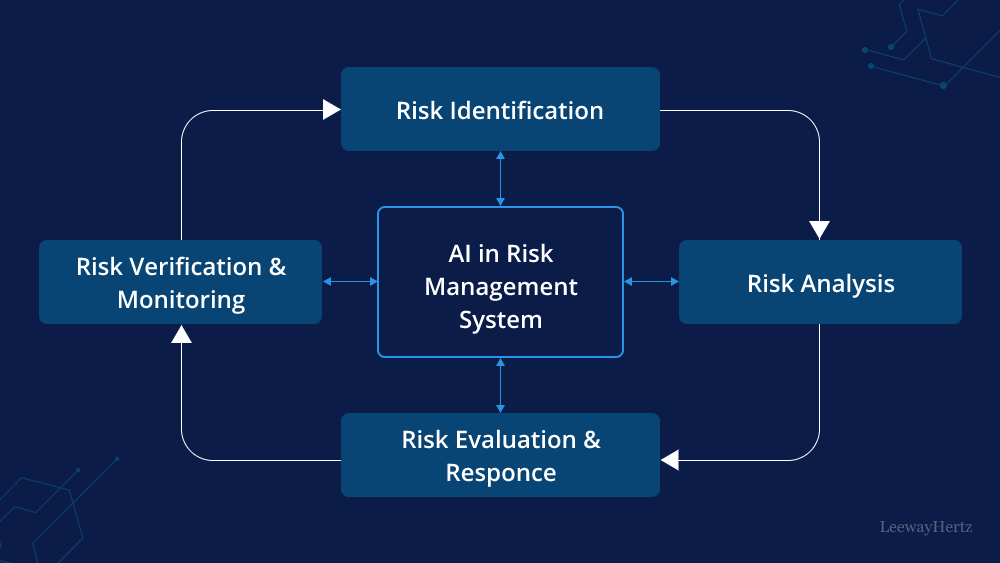
For generations, navigating the US stock market has been a delicate dance between greed and fear, opportunity and risk. Traditional risk management—diversification, stop-loss orders, and fundamental analysis—has been the bedrock of portfolio protection. Yet, in an era defined by algorithmic trading, global macroeconomic shocks, and information overload, these traditional tools can feel like using a paper umbrella in a hurricane. The market’s velocity and complexity have outstripped the capacity of the human mind to process it all in real-time.
Enter Artificial Intelligence (AI). No longer a futuristic concept, AI is rapidly transforming the landscape of investing, shifting the paradigm from reactive risk management to proactive, predictive protection. This article delves into how modern investors can leverage AI to build a more resilient portfolio, capable of withstanding the unique volatilities of the US market.
Part 1: The New Face of Risk – Why Traditional Methods Are No Longer Enough
The US market has always been volatile, but the nature of that volatility has evolved. The 21st century has introduced new, systemic risks that are non-linear, interconnected, and explosively fast-moving.
- The Rise of the Machines: Over 70% of US equity trading is now driven by algorithms. These systems can execute trades in microseconds, creating “flash crashes” and momentum swings that have little to do with company fundamentals. A human simply cannot react to this speed.
- The Information Tsunami: Every day, millions of data points are generated—from earnings reports and Fed statements to satellite images of parking lots and sentiment analysis of social media. No human analyst can synthesize this “alternative data” at scale.
- Complex Interconnectivity: Global supply chains, geopolitical tensions, and intertwined monetary policies mean an event in a distant country can ripple through the US market in hours. Traditional models often fail to capture these second- and third-order effects.
Classic diversification—the cornerstone of Modern Portfolio Theory—can falter during systemic crises, like 2008 or the 2020 pandemic, when correlations between asset classes converge to 1 (meaning everything falls together). Stop-loss orders can be triggered en masse during a sharp downturn, locking in losses and exacerbating the sell-off.
This is not to say these tools are obsolete. They are, however, insufficient on their own. They are defensive linemen trying to stop a blur of a running back; they need a sophisticated, AI-powered defensive coordinator calling the plays.
Part 2: Demystifying the AI Arsenal – From Machine Learning to Deep Neural Nets
Before we explore applications, it’s crucial to understand what we mean by “AI” in an investment context. It’s not a single, sentient machine picking stocks. It’s a suite of technologies.
- Machine Learning (ML): The core of most financial AI. ML algorithms learn from historical data to identify patterns and make predictions without being explicitly programmed for every rule. For example, an ML model can be trained on decades of market data to recognize the precursors to a 10% correction.
- Natural Language Processing (NLP): This is how AI “reads.” NLP algorithms can scan thousands of earnings call transcripts, SEC filings, news articles, and even Twitter feeds in seconds. They can gauge market sentiment, identify key themes, and detect subtle shifts in managerial tone that might be missed by a human reader.
- Deep Learning and Neural Networks: A more complex subset of ML, loosely modeled on the human brain. These are excellent at finding intricate, non-obvious patterns in vast, unstructured datasets (e.g., predicting retail sales by analyzing satellite images of shopping mall traffic).
- Reinforcement Learning: Here, an AI agent learns by trial and error, much like a human learning a game. It takes actions (e.g., adjusting portfolio weightings) and receives rewards or penalties based on the outcomes (portfolio returns, volatility). Over millions of simulated trading sessions, it learns an optimal risk-management strategy.
Part 3: AI in Action – Practical Applications for the Modern Investor
So, how does this technological prowess translate into tangible portfolio protection? Let’s explore key applications.
1. Sentiment Analysis and Predictive Risk Modeling
Humans are notoriously bad at separating signal from noise. AI excels at it.
- How it works: NLP systems continuously parse a universe of text-based data—financial news, analyst reports, central bank communications, and social media. They don’t just count keywords; they understand context, sarcasm, and urgency. They aggregate this into a quantitative “fear & greed” or “sentiment” score.
- Practical Use Case: An AI tool detects a sharp, coordinated negative shift in sentiment across news outlets and social media regarding inflation data. Concurrently, it analyzes the Fed Chairman’s latest speech and detects a more hawkish tone than the market initially perceived. The system flags a high probability of a volatility spike and suggests reducing exposure to high-multiple growth stocks, which are most sensitive to interest rate fears, before the major sell-off begins.
2. Dynamic Portfolio Optimization and Hedging
Modern Portfolio Theory gives us a static “efficient frontier.” AI gives us a dynamic one.
- How it works: AI-powered platforms can run millions of Monte Carlo simulations, stress-testing your portfolio against thousands of potential future scenarios (e.g., “What happens if oil spikes 50% and the dollar collapses 20%?”). They don’t just rely on historical correlations but can predict how correlations might change under stress.
- Practical Use Case: Instead of a simple 60/40 stock/bond split, an AI system might recommend a nuanced allocation: 45% US equities, 10% international value stocks, 25% long-term treasuries, 15% commodities, and 5% cash. It then dynamically adjusts these weights. If its models predict rising recession risk, it might automatically increase the treasury and cash allocation while reducing equity exposure, and even suggest specific, cost-effective options contracts to hedge the remaining equity risk.
3. Algorithmic Execution and Volatility Smoothing
For active traders, “how” and “when” you trade is as important as “what” you trade.
- How it works: AI execution algorithms break large orders into smaller pieces to minimize market impact. They analyze real-time order book data, liquidity, and intraday volatility patterns to find the optimal moments to trade.
- Practical Use Case: You need to sell a large position in a relatively illiquid stock. A “dumb” market order could crash the price. An AI-powered execution algorithm will work the order throughout the day, selling more shares when liquidity is high and volatility is low, and pausing during turbulent periods, thereby achieving a significantly better average execution price and reducing transaction costs—a direct form of risk management.
4. Fraud and Anomaly Detection
Company-specific risk, or “idiosyncratic risk,” can devastate a concentrated portfolio.
- How it works: AI can scan financial statements and operational data for red flags and subtle anomalies that might indicate accounting irregularities or operational decline. It can compare a company’s metrics to its peers and historical trends.
- Practical Use Case: An AI system monitoring your holdings flags that a mid-cap company you own has reported revenue growth, but its accounts receivable are growing three times faster—a classic warning sign of potentially inflated sales. It alerts you to investigate further, potentially allowing you to exit the position before a major scandal or restatement erupts.
Read more: Beyond the 401(k): Mastering the Three Pillars of US Retirement Savings
Part 4: A Practical Guide to Adopting AI Tools – From Robo-Advisors to Advanced Platforms
You don’t need a PhD in data science to harness AI for risk management. The tools are now accessible at various levels of sophistication and cost.
Level 1: The Retail Investor – AI-Powered Robo-Advisors
- Examples: Betterment, Wealthfront, Charles Schwab Intelligent Portfolios.
- What they do: These platforms use basic AI and Modern Portfolio Theory to build and manage a diversified ETF portfolio for you. Their primary risk-management value is in automated rebalancing and tax-loss harvesting.
- Risk Management Capability: Basic to Moderate. Excellent for long-term, set-and-forget investors seeking low-cost diversification, but lacks the predictive, forward-looking capabilities of more advanced systems.
Level 2: The Sophisticated Retail / Accredited Investor – AI-Enhanced Brokerage and Research Tools
- Examples: Interactive Brokers, BlackRock’s Aladdin, Morningstar’s Mo.
- What they do: These platforms integrate AI-driven analytics directly into their trading and research workflows. You might get alerts on unusual options activity, volatility forecasts, or NLP-driven sentiment scores on your watchlist stocks.
- Risk Management Capability: Moderate to High. Puts powerful data and signals at your fingertips, but still requires you, the investor, to interpret and act on them.
Level 3: The Professional and Institutional Investor – Dedicated AI Investment Platforms
- Examples: Two Sigma, Aidyia, EquBot (the AI behind the AI Powered Equity ETF – AIEQ).
- What they do: These are the cutting edge. They use deep learning and multiple AI models to run fully or semi-autonomous investment strategies. They make decisions based on a vast array of alternative data.
- Risk Management Capability: High to Very High. This is where AI moves from being an assistant to being the primary portfolio manager, with risk management baked into its core decision-making process. Access is often limited to high-net-worth individuals or institutions.
Part 5: The Human-in-the-Loop – Navigating the Pitfalls and Ethical Quagmires
AI is a powerful tool, not a magic wand. Blind reliance on algorithms is a recipe for disaster. The most successful approach is a symbiotic “Human-in-the-Loop” model.
Key Risks and Limitations of AI:
- Garbage In, Garbage Out (GIGO): An AI model is only as good as the data it’s trained on. If trained on a period of perpetual low volatility (e.g., the post-2009 bull market), it may be dangerously unprepared for a black swan event.
- Overfitting: A model can become so finely tuned to past data that it fails to predict the future. It finds patterns in the historical noise that are not repeatable. An overfitted model looks brilliant in back-testing but fails catastrophically in live markets.
- Model Black Box: Many complex AI models, especially deep learning networks, are “black boxes.” It can be difficult or impossible to understand why they made a specific decision. This lack of explainability can be a major trust issue, especially when large amounts of capital are at stake.
- Herding and Systemic Risk: If multiple major funds use similar AI models and data sources, they can all reach the same conclusion simultaneously, creating a new form of herding that amplifies market moves and creates flash crashes.
The Irreplaceable Human Role:
- Strategic Oversight and Common Sense: The human investor sets the overall strategy, risk tolerance, and ethical constraints. An AI might suggest a highly leveraged trade; the human must apply judgment and veto it if it violates their core principles.
- Context and Nuance: AI can detect a negative sentiment shift, but a human is needed to understand the geopolitical or social context behind it. Is it a fleeting scandal or a fundamental regime change?
- Accountability: Ultimately, the human is accountable for the performance and risks of the portfolio. You cannot blame the algorithm.
Conclusion: Forging a Smarter Defense
The US market’s volatility is not a beast to be tamed, but a force to be navigated. In the Machine Age, Artificial Intelligence provides the most sophisticated navigation system ever devised. It equips investors with predictive insights, dynamic optimization, and execution efficiency that were once the exclusive domain of Wall Street titans.
The goal is not to replace the investor, but to augment them. By combining the raw processing power and pattern-recognition capabilities of AI with human judgment, intuition, and strategic oversight, you can build a portfolio that is not only designed for growth but engineered for resilience. In the relentless storm of market volatility, AI is the keel that keeps your ship upright and on course, allowing you to sail toward your financial goals with greater confidence and control.
Read more: Healthcare in Retirement: Navigating Medicare and Estimating Costs in the USA
Frequently Asked Questions (FAQ)
Q1: Is AI risk management only for large institutional investors or tech-savvy day traders?
A: Absolutely not. While the most advanced systems are for institutions, the technology has trickled down. Retail investors can access core AI risk-management features through popular robo-advisors (like automated rebalancing and tax-loss harvesting) and mainstream brokerage platforms that now offer AI-driven analytics and alerts. The barrier to entry is lower than ever.
Q2: How can I trust an AI’s recommendation if it’s a “black box” I don’t understand?
A: This is a critical challenge. The solution is to start with a “Human-in-the-Loop” approach. Use the AI as a powerful recommendation engine, not an autopilot. If an AI suggests a significant portfolio change, treat it as a top-tier research report. Ask questions: What data is this based on? Does this align with my investment thesis? Does it fit my risk profile? Use the AI’s output to inform your decision, not to make it for you. Over time, as you see the quality and logic of its suggestions, trust can be built organically.
Q3: Couldn’t a bug or error in the AI’s code cause a massive, instantaneous loss?
A: The risk of a catastrophic coding error exists, but it’s mitigated in several ways. First, reputable platforms use rigorous testing and redundancy. Second, a prudent investor should never give an AI system unchecked control over their entire portfolio. Always maintain oversight and the ability to intervene. The real risk is often not a sudden bug but more subtle issues like “model drift,” where the AI’s performance degrades over time as market dynamics change, highlighting the need for continuous human monitoring.
Q4: How does AI-driven risk management differ from simple diversification?
A: Diversification is a static, structural defense—it’s like building a wall. AI-driven risk management is a dynamic, active defense—it’s like having a team of scouts and a mobile rapid-response unit. Diversification assumes historical relationships between assets will hold. AI actively monitors for when those relationships are breaking down and can adjust the portfolio before a crisis hits, or can use sophisticated hedging strategies that go beyond simple asset allocation.
Q5: What is the single biggest mistake investors make when first using AI tools?
A: The biggest mistake is overconfidence. They see the advanced technology and assume it’s infallible, leading them to abdicate their own judgment and override their own investment policy statement. This can lead to taking on excessive risk based on an AI’s back-tested (but potentially overfitted) performance. The key is to start small, use AI to enhance your existing process, and never stop being the final decision-maker for your capital.