
Artificial intelligence is increasingly shaping how everyday investors research markets, manage risk, and execute trades. From algorithmic stock screeners to automated portfolio tools, AI-assisted trading is no longer limited to hedge funds or institutional firms. Retail investors across the United States are adopting these systems to improve efficiency, reduce emotional decision-making, and better analyze market data, though important limitations and risks still remain.
The Growing Presence of AI in Retail Trading
Over the last several years, artificial intelligence has steadily moved from institutional finance into the hands of ordinary investors. What was once available only to large Wall Street firms is now accessible through mobile trading apps, subscription-based analytics platforms, and brokerage tools aimed at everyday users.
Much of this shift has been driven by improvements in machine learning, cloud computing, and financial data availability. Retail investors today can access tools that analyze technical indicators, summarize earnings reports, identify trading patterns, and even generate automated trading signals in real time.
The rise of commission-free trading platforms also accelerated interest in AI-powered investing. As more Americans entered the market during and after the pandemic-era retail investing boom, demand grew for systems that could simplify research and reduce manual analysis.
According to data from JPMorgan Chase & Co. and Deloitte, retail investors are increasingly using AI-enhanced financial platforms for portfolio management, market research, and predictive analytics. Many younger investors, particularly those under 40, now expect some form of AI assistance inside financial apps.
What makes this trend particularly notable is that AI trading tools are no longer marketed solely toward advanced traders. Many platforms now present AI as a practical assistant rather than a replacement for human judgment.
What AI-Assisted Trading Actually Means
AI-assisted trading refers to the use of artificial intelligence technologies to support investment decisions. Importantly, this does not always mean fully automated trading bots making independent decisions.
For most everyday investors, AI assistance falls into several categories:
- Market trend analysis
- Automated technical chart recognition
- News and sentiment analysis
- Risk management suggestions
- Portfolio rebalancing
- Trade signal generation
- Strategy backtesting
- Pattern detection across historical data
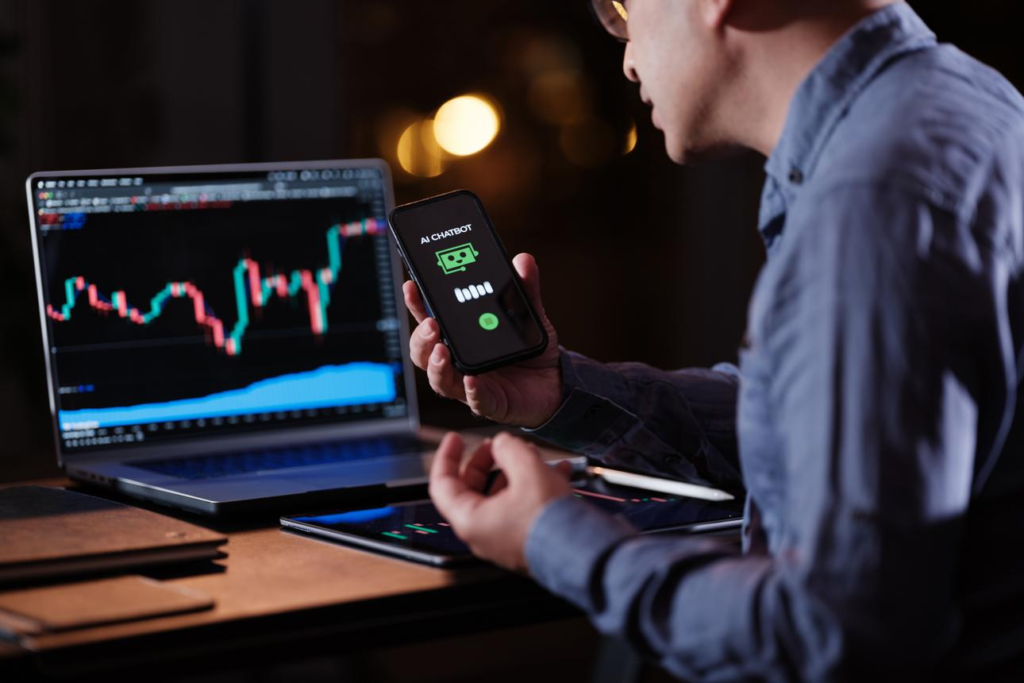
In practice, many retail traders use AI as a decision-support layer rather than a fully autonomous system.
For example, a swing trader may use an AI-powered screener to identify stocks with unusual volume activity and then manually review the charts before entering a position. Another investor may rely on machine-learning tools to summarize earnings calls or evaluate broader market sentiment.
This distinction matters because much of the public conversation around AI trading incorrectly assumes that investors simply “turn on a bot” and generate passive profits. In reality, most successful users combine AI-generated insights with personal risk management and market experience.
Why Everyday Investors Are Becoming Interested
Several forces are contributing to the rapid adoption of AI-assisted trading strategies among retail investors in the United States.
Information Overload
Modern financial markets generate enormous amounts of data every day. Earnings reports, Federal Reserve announcements, inflation metrics, geopolitical developments, analyst ratings, and social media sentiment can all influence price action.
For individual investors managing full-time jobs or businesses, manually processing this information has become increasingly difficult.
AI tools help reduce this burden by summarizing information quickly and highlighting potentially relevant signals.
Faster Market Reactions
Markets now react to news within seconds. Institutional firms have used automation for years to respond rapidly to price movements.
Retail investors increasingly view AI-assisted tools as a way to remain competitive in an environment where manual analysis alone may not be sufficient.
Emotional Discipline
One of the most commonly cited advantages of AI-assisted trading is emotional consistency.
Human traders often struggle with:
- Fear during volatility
- Overtrading
- Revenge trading
- Panic selling
- Holding losing positions too long
AI systems do not eliminate emotional mistakes entirely, but structured rule-based trading can reduce impulsive behavior.
Accessibility of Advanced Tools
Five years ago, many advanced trading tools were expensive or limited to professionals. Today, AI-enhanced platforms are widely available through affordable subscriptions or built directly into brokerage apps.
This accessibility has dramatically lowered the barrier to entry.
How AI Trading Tools Are Commonly Used
Retail investors are applying AI in different ways depending on their trading style, experience level, and risk tolerance.
Day Traders
Short-term traders often use AI systems for:
- Momentum scanning
- Real-time alerts
- Volume spike detection
- Automated chart pattern recognition
- Entry and exit signal assistance
For example, an intraday trader monitoring the NASDAQ may use AI-powered scanners to identify unusual options activity before a breakout occurs.

Swing Traders
Swing traders frequently use AI to analyze multi-day or multi-week market patterns.
These tools may identify:
- Trend continuation setups
- Relative strength
- Support and resistance zones
- Historical probability models
Many swing traders still execute trades manually but rely on AI for faster research.
Long-Term Investors
Long-term investors often use AI differently than active traders.
Common use cases include:
- Portfolio diversification analysis
- Risk-adjusted allocation suggestions
- Earnings trend evaluation
- ETF screening
- Macro-economic forecasting
Rather than seeking rapid trades, these investors focus on improving decision quality over time.
The Role of Machine Learning in Market Analysis
Machine learning allows trading systems to identify patterns across massive datasets. Unlike static rule-based software, machine-learning systems can adapt as they process new information.
For example, an AI model may analyze:
- Historical price action
- Earnings surprises
- Interest rate movements
- Volatility patterns
- Social sentiment
- Institutional order flow
The system can then estimate probabilities for future price movement based on similar historical conditions.
However, there is an important limitation that experienced investors frequently emphasize: markets constantly evolve.
A strategy that performs well during one market cycle may fail during another.
This is one reason professional traders often warn against blindly trusting AI-generated signals without independent validation.
Common Misconceptions About AI Trading
As AI trading becomes more mainstream, several misconceptions continue to circulate online.
“AI Predicts Markets Perfectly”
No AI system can consistently predict markets with perfect accuracy.
Financial markets are influenced by unpredictable human behavior, geopolitical developments, and macroeconomic changes that no algorithm can fully anticipate.
Even institutional quantitative funds experience losses.
“Automated Trading Eliminates Risk”
AI may improve efficiency, but it does not remove financial risk.
Poorly designed systems can:
- Overfit historical data
- Fail during unusual volatility
- Generate false signals
- Amplify losses during rapid market reversals
Risk management remains essential regardless of how advanced the software appears.
“More Automation Always Means Better Results”
Some investors mistakenly believe fully automated systems outperform semi-automated approaches.
In reality, many experienced traders prefer AI assistance rather than full automation because human judgment still matters during unusual market conditions.
The Influence of Social Media and Online Communities
The popularity of AI-assisted trading has also been fueled by online communities across YouTube, Reddit, Discord, and financial forums.
Content creators frequently showcase:
- Trading bot demonstrations
- AI-generated strategy testing
- Automated stock scanning systems
- Machine-learning dashboards
- Portfolio optimization tools
While some educational content is genuinely valuable, there is also substantial misinformation online.
Retail investors should be cautious of:
- Unrealistic profit screenshots
- “Guaranteed” AI systems
- Unverified backtests
- Hidden affiliate marketing incentives
- Black-box strategies with no transparency
A growing number of experienced investors now prioritize transparency over complexity when evaluating AI trading systems.
Regulatory and Ethical Considerations
As AI trading adoption expands, regulators are increasingly paying attention to algorithmic decision-making in retail investing.
Questions surrounding transparency, accountability, and investor protection continue to evolve.
Potential concerns include:
- Misleading AI marketing claims
- Automated financial advice without oversight
- Data privacy issues
- Market manipulation risks
- Unclear model decision logic
Organizations such as the U.S. Securities and Exchange Commission have repeatedly emphasized that investors should understand how automated tools function before relying heavily on them.
Some brokerage firms now include clearer disclosures explaining that AI-generated insights are informational rather than guaranteed recommendations.
What Experienced Investors Tend to Do Differently
One noticeable pattern among experienced AI-assisted traders is that they rarely depend on a single system.
Instead, they typically combine:
- AI-generated insights
- Personal market research
- Risk controls
- Position sizing rules
- Macro-economic awareness
- Manual trade confirmation
For example, an investor might receive an AI-generated bullish signal on a semiconductor stock but still wait for confirmation through earnings guidance, sector strength, or technical support levels.
This layered approach often produces more consistent outcomes than relying solely on automation.
Experienced traders also spend significant time evaluating system reliability.
They commonly ask:
- Was the strategy tested across multiple market conditions?
- How does it perform during high volatility?
- Is the data source trustworthy?
- Are transaction costs included in backtests?
- Does the strategy encourage excessive leverage?
These questions help separate sustainable systems from overly optimized marketing products.
The Hidden Challenge of Data Quality
One overlooked issue in AI trading is data quality.
AI systems are only as reliable as the information they receive.
Poor-quality inputs can produce misleading outputs, including:
- Delayed pricing data
- Inaccurate financial statements
- Biased sentiment analysis
- Incomplete historical records
Retail investors often underestimate how much institutional firms invest in high-quality data infrastructure.
As a result, many lower-cost AI platforms may still struggle with reliability during fast-moving market conditions.
This does not make retail AI tools useless, but it highlights the importance of realistic expectations.

Questions Many New Investors Are Asking
Is AI trading legal in the United States?
Yes. AI-assisted trading tools are legal in the U.S. as long as they comply with applicable financial regulations and brokerage requirements.
Can beginners use AI trading platforms?
Many platforms are designed for beginners, though understanding basic investing principles remains important before relying heavily on automation.
Do AI trading systems outperform human traders?
Some AI-assisted systems can improve efficiency and data analysis, but no system consistently outperforms all market participants across every environment.
Are AI-generated trade signals reliable?
Reliability varies significantly depending on the data quality, strategy design, and market conditions.
Do professional investors use AI?
Yes. Institutional firms have used algorithmic and AI-assisted trading systems for decades, though retail-accessible tools are generally less sophisticated.
Where AI-Assisted Investing May Be Headed Next
The next phase of AI-assisted trading will likely focus less on fully autonomous bots and more on intelligent decision support.
Emerging developments may include:
- Personalized AI market assistants
- Natural-language trade analysis
- Voice-based portfolio monitoring
- Adaptive risk management systems
- Cross-market predictive modeling
- AI-enhanced macroeconomic forecasting
Brokerage platforms are also expected to integrate AI more deeply into user experience rather than treating it as a separate premium feature.
At the same time, investors may become more selective as the market matures. Many early AI trading products relied heavily on marketing language, but users are increasingly prioritizing transparency, reliability, and risk management.
This shift could ultimately benefit long-term investors by encouraging more realistic expectations around what AI can and cannot do.
Reading the Market Without Losing Human Judgment
AI-assisted trading is changing how everyday investors interact with financial markets, but the technology works best when viewed as a tool rather than a shortcut.
The most effective retail investors typically use AI to improve research efficiency, identify patterns faster, and maintain structure in decision-making. They do not assume algorithms can eliminate uncertainty or replace disciplined risk management.
As AI tools continue to evolve, the investors most likely to benefit may not be those chasing complete automation, but those learning how to combine technology with sound financial judgment, patience, and adaptability.
Key Insights Worth Remembering
- AI-assisted trading is becoming increasingly common among retail investors
- Most successful investors use AI as decision support rather than full automation
- Emotional discipline is one of the primary benefits of rule-based systems
- Data quality significantly affects AI trading performance
- No AI system can consistently predict markets with perfect accuracy
- Experienced traders still rely heavily on risk management
- Transparency matters more than marketing complexity
- AI tools are likely to become standard features in brokerage platforms
- Retail investors should remain cautious of exaggerated performance claims
- Human judgment continues to play an essential role in investing