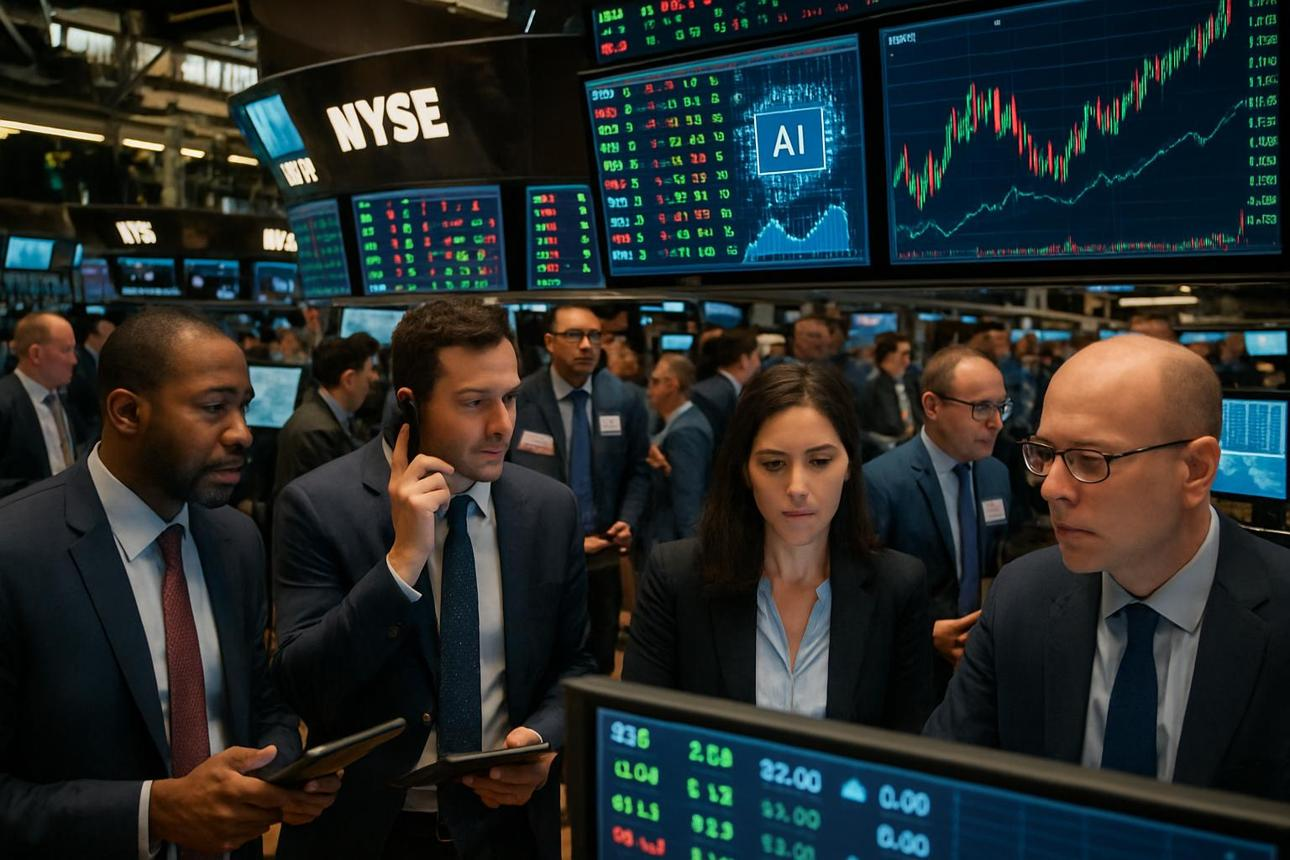
Artificial intelligence is reshaping how investors analyze markets, manage risk, and execute trades. Experienced traders are increasingly focusing on AI tools that improve speed, pattern recognition, and decision support rather than promising unrealistic profits. The most effective approaches combine human judgment with machine-driven insights, emphasizing disciplined risk management, data quality, and adaptability in changing market conditions.
Why AI Trading Is No Longer a Niche Strategy
AI trading has moved from hedge-fund experimentation into mainstream investing conversations. Large financial institutions, proprietary trading firms, and retail investors are all exploring how machine learning systems can help interpret market data faster than traditional analysis methods.
The shift is happening for several reasons. Markets generate enormous amounts of information every second, including price movement, earnings reports, macroeconomic data, options activity, and social sentiment. Human traders can interpret only a fraction of that data in real time. AI systems, however, can process multiple data streams simultaneously and identify correlations that may otherwise go unnoticed.
Experienced investors are not necessarily replacing traditional analysis with automation. Instead, many are using AI as an enhancement layer. The goal is often to improve consistency, reduce emotional decision-making, and identify higher-probability setups.
According to research published by McKinsey & Company, AI adoption across financial services continues to accelerate as firms seek efficiency, predictive analytics, and improved operational decision-making.
For individual investors, the landscape has also changed significantly. AI-powered trading platforms, algorithmic assistants, portfolio optimization tools, and predictive analytics dashboards are now widely accessible at consumer-level pricing.
What Experienced Investors Actually Look for in AI Trading Systems
A common misconception is that professional traders focus primarily on “winning algorithms.” In reality, experienced investors evaluate AI systems based on reliability, transparency, and risk management.
Several qualities tend to matter more than raw return projections.
1. Risk Control Comes Before Performance
Professional investors often judge a system by how it performs during volatility rather than during ideal market conditions.
Key questions include:
- How does the system react during rapid market reversals?
- Does it reduce exposure during uncertain conditions?
- Can losses be capped systematically?
- Is leverage controlled intelligently?
Many experienced traders prefer systems designed to minimize catastrophic losses rather than maximize aggressive gains.
For example, during periods of elevated volatility in the S&P 500, some AI systems automatically reduce position sizes or tighten stop-loss thresholds based on historical volatility patterns.
This reflects a broader industry mindset: survival and consistency are more important than short-term spikes in performance.
2. Data Quality Is Becoming More Important Than Strategy Complexity
One of the biggest developments in AI trading is the recognition that clean, high-quality data often matters more than sophisticated models.
Poor data can produce misleading predictions regardless of how advanced the algorithm appears.
Experienced investors pay close attention to:
- Historical data accuracy
- Real-time feed reliability
- Latency issues
- Data bias
- Overfitting risks
Overfitting occurs when an AI model performs well on historical data but fails in live market conditions because it learned patterns that do not consistently repeat.
This is one reason many professional traders remain cautious about systems marketed with perfect backtested results.
3. AI Works Best as a Decision Support Tool
Some of the most successful traders using AI do not allow systems to trade autonomously at all times.
Instead, they use AI for:
- Trade screening
- Market scanning
- Sentiment analysis
- Volatility detection
- Pattern recognition
- Portfolio balancing
The final decision often remains human-driven.
For example, an investor may use AI software to identify unusual options activity in technology stocks but still manually evaluate macroeconomic conditions before entering a position.
This hybrid approach is becoming increasingly common because markets can behave irrationally during geopolitical events, economic surprises, or sudden liquidity shifts.
How AI Is Changing Market Analysis
Traditional technical analysis relied heavily on visible chart patterns and historical price action. AI systems now incorporate broader contextual information.
Modern AI trading systems can evaluate:
- Earnings call transcripts
- Federal Reserve commentary
- News sentiment
- Social media momentum
- Institutional trading flows
- Correlated asset behavior
- Sector rotation patterns
Natural language processing models have become particularly influential. These systems analyze language tone and sentiment from financial news or executive commentary to identify potential market reactions.
For instance, subtle wording changes during quarterly earnings calls may influence AI-driven sentiment indicators before broader market participants fully react.
This does not mean AI predicts markets perfectly. Rather, it improves the speed and depth of information analysis.
The Growing Importance of Explainable AI
One of the most important trends among sophisticated investors is the push toward explainable AI.
Black-box algorithms — systems that generate decisions without understandable reasoning — are increasingly viewed with skepticism.
Experienced investors want to understand:
- Why a trade signal was generated
- Which variables influenced the prediction
- How confidence levels are measured
- Whether the model adapts to changing market conditions
Transparency matters because financial markets are highly dynamic environments. Strategies that worked in one economic cycle may fail in another.
For example, AI models trained primarily during low-interest-rate environments may struggle during periods of persistent inflation or tighter monetary policy.
This is why many institutional investors prioritize adaptability and interpretability over aggressive automation.
Are Retail Investors Benefiting From AI Trading?
Retail investors now have access to tools that were once limited to institutional trading desks.
Platforms offering AI-assisted analytics, automated portfolio balancing, and predictive screening tools have become increasingly common in the United States.
However, experienced investors generally emphasize several realities:
AI Does Not Remove Market Risk
No AI system can eliminate uncertainty.
Unexpected events such as:
- Central bank policy shifts
- Geopolitical conflict
- Regulatory changes
- Earnings surprises
- Liquidity crises
can rapidly disrupt algorithmic expectations.
Many retail investors mistakenly assume AI systems guarantee better performance. In practice, AI improves probability assessment — not certainty.
Simplicity Often Outperforms Complexity
Some experienced investors prefer relatively simple systems with disciplined execution rather than highly complex predictive engines.
Examples include:
- Trend-following systems
- Volatility-adjusted allocation models
- AI-enhanced momentum screening
- Sector rotation analysis
These approaches tend to be easier to monitor and evaluate.
Complexity can sometimes increase fragility, especially during unusual market conditions.
Questions Investors Are Commonly Asking About AI Trading
Is AI trading legal in the United States?
Yes. AI-assisted trading is legal in the United States provided firms and investors comply with applicable financial regulations established by organizations such as U.S. Securities and Exchange Commission and Financial Industry Regulatory Authority.
Can AI predict stock market crashes?
AI systems can identify elevated risk conditions or unusual volatility patterns, but no model can consistently predict crashes with complete accuracy.
Most professional systems focus on probability-based risk assessment rather than absolute prediction.
Do professional traders fully trust AI systems?
Most experienced traders use AI selectively rather than blindly trusting automation.
Human oversight remains critical, especially during periods of extreme market stress.
Is AI trading mainly for short-term traders?
Not necessarily.
AI tools are increasingly used in:
- Long-term portfolio management
- Retirement allocation strategies
- Risk modeling
- Tax optimization
- Asset diversification
Many investors use AI primarily for portfolio analysis rather than rapid trading.
What Separates Sustainable AI Trading From Hype
The AI trading industry has attracted aggressive marketing claims over the past several years. Experienced investors are becoming more disciplined in how they evaluate platforms and systems.
Several warning signs frequently appear in questionable offerings:
- Guaranteed return claims
- Unrealistic win-rate promises
- Lack of audited performance data
- Hidden risk exposure
- Excessive leverage strategies
- Opaque methodology
Professional investors typically focus instead on measurable operational qualities.
These include:
- Transparent methodology
- Consistent execution
- Risk-adjusted performance
- Realistic expectations
- Stable infrastructure
- Regulatory compliance
This more cautious approach reflects a broader understanding that markets are inherently uncertain.
The Role of AI During High Volatility Periods
Volatility has become one of the defining characteristics of modern financial markets.
From inflation shocks to interest-rate changes and geopolitical instability, investors increasingly face rapid shifts in sentiment and liquidity.
AI systems can help during these periods by:
- Monitoring large data flows in real time
- Detecting abnormal trading patterns
- Adjusting exposure dynamically
- Identifying liquidity deterioration
- Measuring cross-market correlations
For example, during rapid selloffs, some institutional systems monitor how credit spreads, Treasury yields, currency movements, and equity volatility interact simultaneously.
This multidimensional analysis is difficult for human traders to perform continuously without automation assistance.
Still, experienced investors recognize that AI models can also fail during unprecedented conditions.
That is why many firms maintain manual oversight and risk committees even when advanced automation is involved.
How Experienced Investors Evaluate AI Platforms
Before adopting an AI trading tool, sophisticated investors often conduct extensive evaluation.
Common evaluation criteria include:
Performance Consistency
Investors look for stable, repeatable performance across varying market conditions rather than isolated high-return periods.
Risk Metrics
Metrics often reviewed include:
- Maximum drawdown
- Sharpe ratio
- Volatility exposure
- Correlation risk
- Position concentration
Infrastructure Reliability
System downtime, execution delays, and latency problems can materially affect performance.
Regulatory and Security Standards
Investors increasingly prioritize platforms with strong cybersecurity measures and transparent compliance standards.
Where AI Trading May Be Headed Next
Several emerging developments are attracting attention among experienced investors.
Personalized AI Portfolio Management
AI systems are becoming more tailored to individual risk tolerance, tax circumstances, and long-term financial goals.
Multi-Asset Intelligence
Future systems are expected to analyze relationships between:
- Stocks
- Bonds
- Commodities
- Currencies
- Crypto assets
- Macroeconomic indicators
with greater integration.
Real-Time Adaptive Models
Older trading systems relied heavily on fixed historical assumptions.
Newer AI models increasingly adapt dynamically as market conditions evolve.
Greater Regulatory Oversight
As AI trading adoption expands, regulatory scrutiny is likely to increase regarding transparency, risk disclosure, and automated decision-making standards.
Why the Human Element Still Matters
Despite rapid advances in artificial intelligence, experienced investors continue emphasizing the importance of human judgment.
Markets are influenced not only by data but also by psychology, politics, regulation, and unpredictable external events.
AI systems can improve efficiency and analysis, but they cannot fully replace strategic thinking, discipline, and contextual understanding.
The investors attracting the most attention today are often those combining technological tools with structured risk management and long-term perspective.
That balance may ultimately define the next era of AI-assisted investing more than automation alone.
Investor Signals Worth Watching Over the Next Few Years
The future of AI trading is likely to be shaped less by flashy automation claims and more by practical adoption patterns. Investors paying close attention are focusing on how institutions integrate AI into broader decision-making frameworks rather than replacing human oversight entirely.
The most important shifts may involve transparency, adaptive risk management, and the growing ability to process complex market information efficiently. As AI tools become more accessible, the advantage will likely come not from simply using automation, but from understanding where it adds value — and where human judgment still matters most.
Key Market Observations Investors Are Monitoring
- AI trading adoption is increasing across both institutional and retail markets
- Risk management remains more important than aggressive return projections
- Explainable AI is gaining attention among professional investors
- Data quality is becoming a major competitive factor
- Human oversight still plays a central role in advanced trading environments
- Volatility adaptation is increasingly viewed as a critical system capability
- Regulatory scrutiny around AI-driven financial systems is expected to grow
- Retail investors are using AI more for analysis than full automation
- Hybrid decision-making models are becoming more common
- Long-term portfolio optimization is emerging as a major AI application area
Frequently Asked Questions
1. What is AI trading?
AI trading uses machine learning and data analysis systems to help identify trading opportunities, manage risk, and automate parts of investment decision-making.
2. Is AI trading only for professional investors?
No. Many retail investors now use AI-powered tools for portfolio analysis, market screening, and trade alerts.
3. Can AI outperform human traders?
AI can process information faster than humans, but long-term performance still depends heavily on risk management and market conditions.
4. Are AI trading platforms regulated?
Many platforms operating in the United States must comply with regulations overseen by the SEC and FINRA.
5. What risks exist with AI trading?
Risks include overfitting, unexpected market events, poor data quality, excessive leverage, and technology failures.
6. Do AI systems work during market crashes?
Some systems adapt well to volatility, but no AI model can guarantee protection during extreme market conditions.
7. Is automated trading the same as AI trading?
Not always. Automated trading follows predefined rules, while AI systems may continuously adapt based on new data.
8. What types of investors use AI tools?
Retail traders, hedge funds, asset managers, retirement planners, and institutional firms all use AI-assisted systems.
9. Can beginners use AI trading software?
Yes, although beginners should still understand basic investing principles and risk management before relying on automation.
10. What matters most when evaluating an AI trading platform?
Transparency, risk controls, security standards, performance consistency, and realistic expectations are among the most important factors.